
 close
close

We've brought all our trackers and market indices together in a single hub page. Please Register and Login to access this free content.


Danube congestion continues to tighten general cargo and small dry bulk vessel availability in the Black Sea
Persistent congestion in the Danube River has been lowering vessel availability in the Black Sea, particularly for smaller general cargo tonnage, while also affecting some dry bulk vessels. Prolonged delays are likely to keep regional freight rates high throughout the grain export season.
Read on WeChat: 德路里 | 欧洲多瑙河“堵船”加剧!黑海散杂船运力告急,运价涨势难停
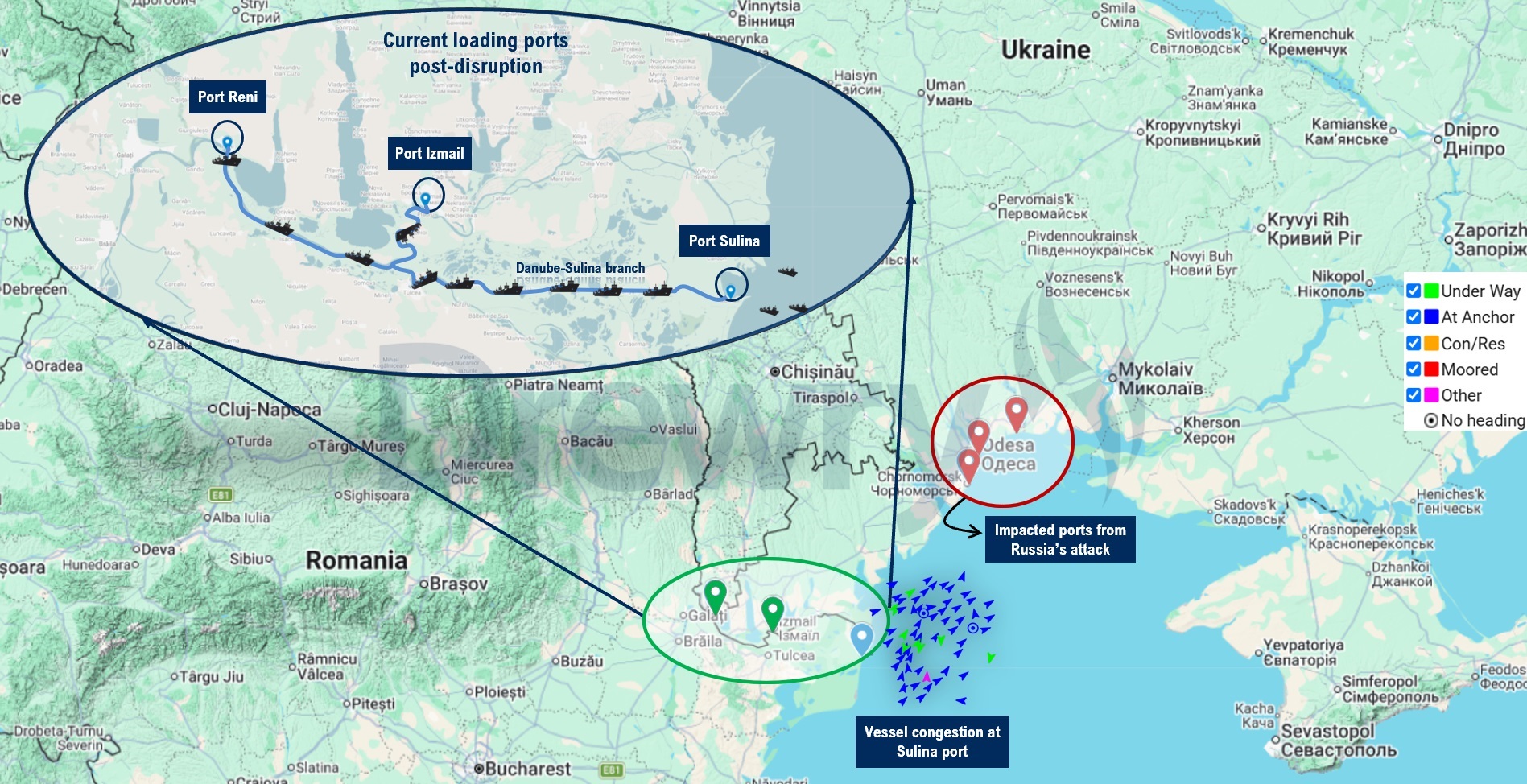
Ukraine’s exports have come under pressure as repeated Russian attacks have disrupted operations at its main Black Sea ports in the Odesa region. The country’s deep-sea ports historically handle most of its grain exports; however, the latest Russian strikes targeted export infrastructure in the region, forcing cargo to be rerouted through lower-capacity Danube ports, including the Port Reni and Izmail. As a result, it is creating massive congestion near the Sulina port, with the current fleet mainly comprising smaller general cargo vessels. Few dry bulk vessels are also caught up in the congestion, putting pressure on vessel availability in the region.
Figure 1: Ukraine’s Black Sea disruptions redirect grain flows towards the Danube
Source: Drewry Maritime Research, Drewry AIS
As Ukrainian grain exports now rely on the Danube corridor, infrastructure and navigational constraints limit vessel throughput and reduce effective fleet availability, supporting freight markets in the Black Sea.
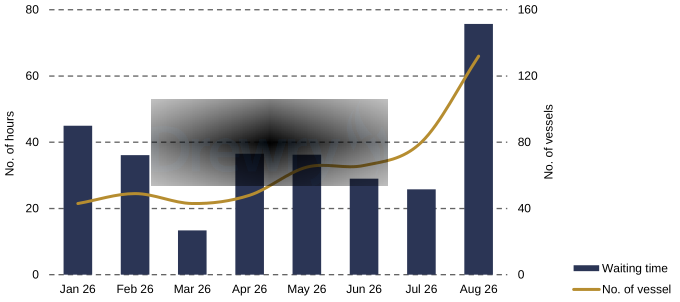
Figure 2: Waiting time at Sulina port for GC vessels spiked 2.5 times in August 2026
Source: Drewry AIS
Regional fleet availability under pressure
Vessel queues at Sulina remain high, with around 70 vessels, including dry bulk and general cargo, awaiting transit, with limited daily passage capacity to Ukrainian Danube ports.
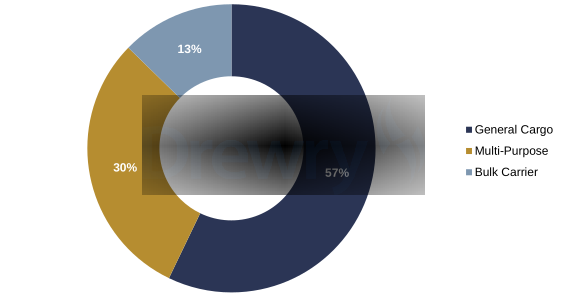
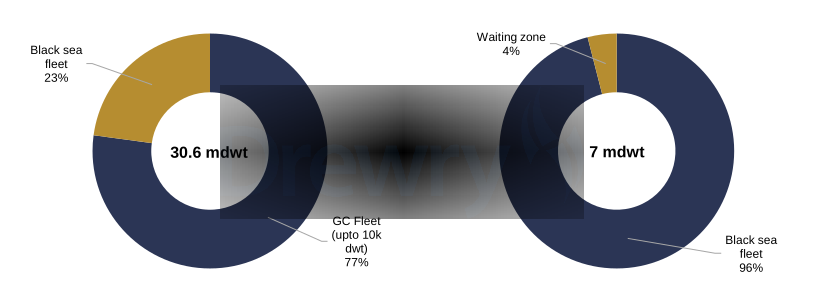
Around 52 (above 2.6 kdwt) general cargo vessels, totalling about 280 kdwt, are currently waiting outside Ukrainian Danube ports. Out of the global fleet of around 30.6 mdwt in this size segment, about 7 mdwt, or 23%, is typically deployed in the Black Sea region, including Russian ports. Although these waiting-zone vessels represent only 4% of the Black Sea fleet (up to 10k dwt), tightening the effective vessel supply, as ongoing delays remove a major portion of the fleet from the active fleet.
Figure 4: General Cargo (Up to 10k dwt) - Black Sea fleet vs waiting at Romania’s Sulina Canal
Source: Drewry AIS
The congestion can be attributed to several factors rather than a single capacity constraint. Pilot shortages, prioritisation of higher-priority cargoes such as fuel, frequent air-raid alerts and weather-related interruptions have reduced the effective flow of vessels, leading to only three to four vessels transiting per day moving towards Ukraine, which could still take several weeks to clear.
According to official data, Ukraine's grain exports were down almost 70% YoY in August, illustrating the extent to which the disruption is affecting the country’s overall grain flows despite efforts to divert cargo to the Danube. However, it has handled much larger volumes in the past when Russia had blocked Ukraine’s Black Sea ports. Grain export capacity through the Danube reached about 2.5 million tonnes per month during 2022-23. However, current volumes remain well below those levels, highlighting congestion even before the route has returned to its previous peak throughput.
Congestion supporting freight fundamentals
The main impact has been a reduction in effective vessel supply. Extended waiting times have increased ballast and voyage inefficiencies, keeping vessels occupied without generating revenue. As congestion persists, owners are more likely to factor waiting-time risk into freight negotiations, while charterers face a shrinking pool of available fleet.
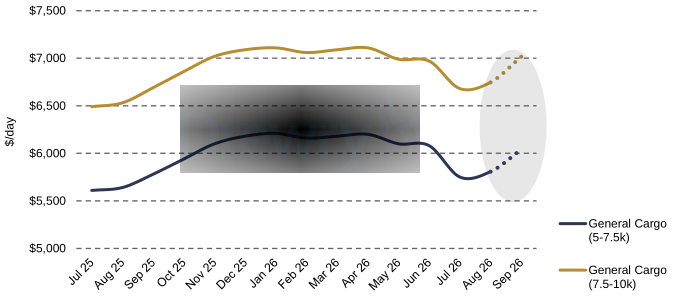
Given the relatively concentrated deployment of sub-10,000 dwt vessels within the Black Sea, even modest increases in delays can have a massive impact on vessel availability, adding $7,000pd cost. This should continue to support regional voyage and time-charter rates in the small general cargo segment in this particular region.
Grain export patterns favour smaller general cargo vessels
The disruption is likely to hamper conventional dry-bulk demand, as a significant portion of cargo is being redirected via the Danube and carried by general cargo vessels. Draft restrictions and port infrastructure limitations mean cargoes previously moved on larger Handysize and Handymax bulkers are increasingly divided into smaller parcels.
As a result, cargoes that would traditionally have been carried by dry-bulk vessels from deep-sea ports are increasingly being absorbed by smaller general-cargo vessels. This represents a degree of substitution away from conventional bulk tonnage, particularly for smaller parcel sizes.
General cargo market outlook
The implications are most pronounced for the general cargo fleet. Nearly one-quarter of the world's sub-10,000 dwt fleet operates in the wider Black Sea market. Persistent congestion at Sulina is tightening vessel supply in a region that already plays a key role in grain and project cargo trades.
If Ukrainian Danube export flows remain elevated, congestion is likely to sustain higher fleet utilisation and limit vessel availability throughout the grain export season; this points towards a positive outlook for regional general cargo earnings, with upside potential for both voyage and time-charter rates even without significant growth in overall cargo volumes.
Want to understand the wider market implications? Our premium DrewryOnDemand analysis explains vessel availability, fleet utilisation and freight-rate implications across the general cargo and small dry bulk segments.
Return to...
Key Contacts





© Copyright 2026 | Drewry Shipping Consultants Limited. All Rights Reserved. Website Terms of Use | Privacy Policy