
 close
close

We've brought all our trackers and market indices together in a single hub page. Please Register and Login to access this free content.


Demand volatility of the petchem sector to reshape LPG shipping dynamics in 2026
LPG demand as a petchem feedstock is likely to be volatile in 2026, driven by the easing petchem expansion in China, consolidations in mature markets such as Japan and South Korea and a downward spiral underway in Europe. Meanwhile, India emerges as a bright spot with its uneven yet expanding trajectory.
With downstream product prices at near breakeven, PDH margins remained volatile in 2025, forcing owners to trim operating rates to stem losses. Therefore, the petchem sector is entering a period of structural adjustment, with shutdown/consolidation of older and smaller units.
LPG has historically relied heavily on residential and commercial consumption, while its demand in the petchem sector has surged over the years. However, fast-evolving petchem feedstock choices, influenced by economics, geopolitical events, trade policy changes and persistent global petchem overcapacity with weak downstream margins, are now reshaping shipping fundamentals, from freight rates, vessel deployment to fleet investment strategies.
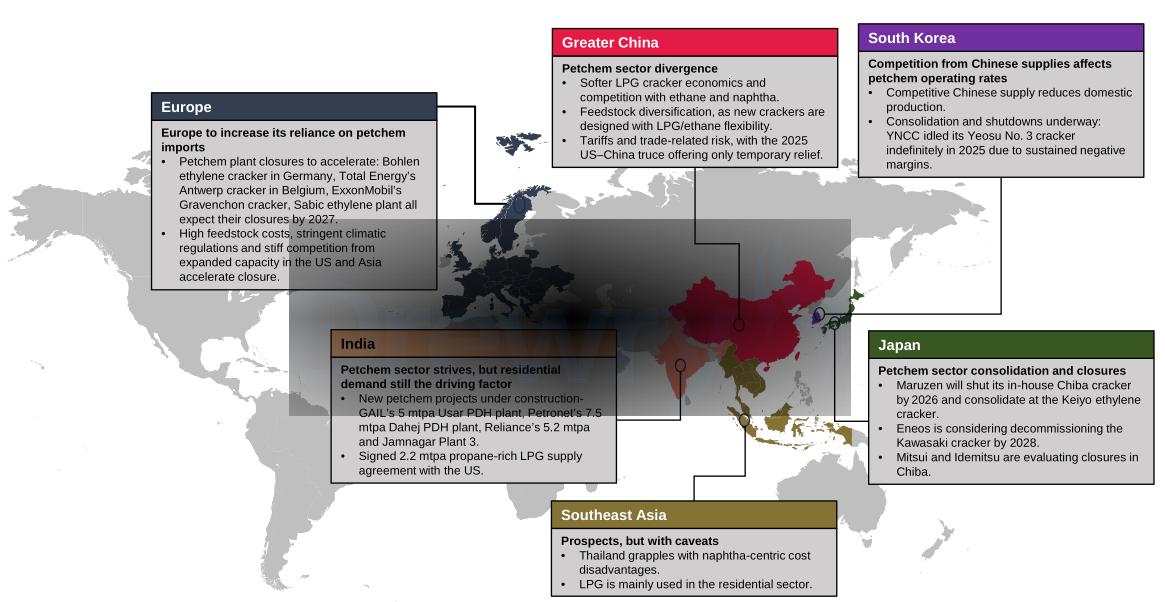
Figure 1: Regional analysis: Country-specific constraints in the petchem sector
Source: Drewry Maritime Research
These developments, coupled with tightening margins, are expected to accelerate consolidation across the petchem sector and delay project timelines. For instance, China has already initiated a consolidation campaign targeting ageing smaller units to enhance overall efficiency. Meanwhile, some PDH operators are considering a month-long shutdown due to low demand. Overall, the impact on operating rates at existing and consolidated units is likely to be positive.
The restructuring of naphtha and coal-based plants is a strategic move which could boost operating rates at newer PDH facilities and support LPG demand.
At the same time, these shifts will drive a regional concentration of petchem capacity, with China increasingly capturing the market share previously held by Japan, South Korea and parts of Europe. As this transition unfolds, two trends may emerge: 1) A rise in intra Asia trade flows, with greater volumes originating from China and 2) the potential development of an Asia–Europe petchem trade route.
However, the viability of the latter will depend on the normalisation of shipping activity through the Red Sea, as vessels transiting via the COGH continue to limit the viability of these flows by closing arbitrage on the Asia–Europe route. Given the ongoing and renewed geopolitical tensions, a return to stable Red Sea operations is unlikely in the near term.
Feedstock competition to be a key determinant of Asia’s LPG demand trajectory in 2026
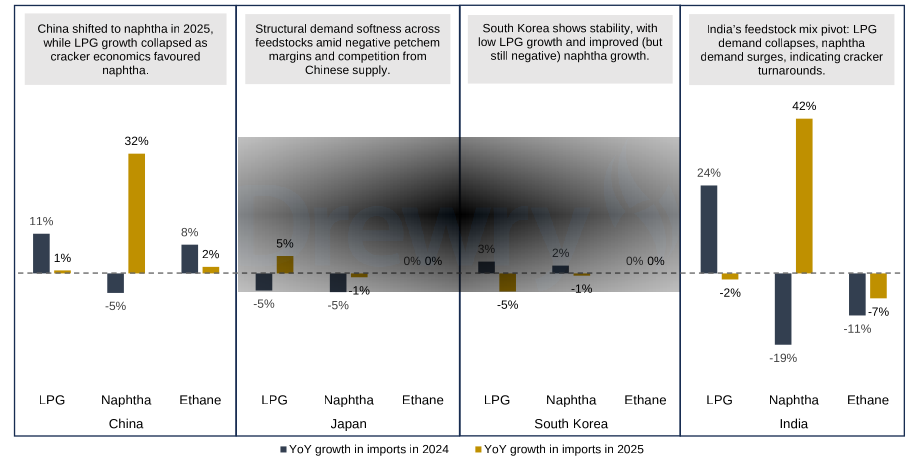
Over the years, deeply discounted propane encouraged higher LPG use in Asian steam crackers, but the resulting demand later narrowed discounts and enabled naphtha to regain share. In 2026, growing US and Middle East LPG supply and rising cracker flexibility may still generate periodic LPG switching opportunities, though persistent olefins oversupply and weak netbacks will limit the margin benefit.
Naphtha is likely to become more expensive for Chinese crackers as China extends its consumption tax in 1Q26. While rebates will apply for petchem use, domestically sourced naphtha will still incur a non refundable 10–12% “social tax,” raising effective costs and making LPG more attractive, as LPG remains exempt from the consumption tax and import quotas.
External factors may further tighten the global naphtha market. Removal of China’s tax exemption for imported naphtha would raise landed costs, while increased Venezuelan crude flows into the US could boost US naphtha demand for gasoline blending. Both these developments favour LPG as it is economical.
Ethane remains the lowest cost feedstock, and Asia’s ethane fed capacity continues to expand. China’s ethane imports, entirely sourced from the US, are set to expand further in 2026 as new units come online. However, complete reliance on US supply exposes these crackers to trade policy and geopolitical risk, tempering ethane’s cost advantage.
Figure 2: LPG–Naphtha arbitrage shift drives demand changes in Asia
Source: TDM, Drewry Maritime Research
Trade tensions weigh on downstream LPG demand
Geopolitical factors are likely to put pressure on downstream LPG demand in 2026. The US–China truce in 2025 briefly improved the sentiment and reopened spot flows, but Saudi acceptances released in December 2025 revealed China’s growing shift towards Middle Eastern supply. Any renewed escalation could quickly erode petchem margins and reshuffle cargo sourcing, tilting volumes between the US and the Middle East, and alter preferred routes such as Panama vs COGH.
At the same time, higher shipping risk premiums amid the Middle East tensions, or added compliance costs linked to European decarbonisation policies, can easily distort arbitrage and trigger feedstock switches. While regional players have adapted by diversifying supply sources and leveraging flexible crackers, policy driven volatility will continue to cast a shadow over LPG trade flows in 2026.
How this reshapes supply demand and shipping in 2026
- LPG demand: Asia remains the core demand hub, but petchem‑linked LPG consumption will stay muted as weak margins, China’s strained PDH economics and steam crackers toggling between LPG and naphtha cap swing demand. India and Southeast Asia continue to expand residential use of LPG, yet petchem demand softens as capacity rationalisation accelerates and seasonal heating/autogas demand remains broadly stable.
- LPG supply: The US and Middle East increase LPG supply through terminal expansions and new gas projects, with Asia absorbing the bulk of volumes. A continued US–China truce would revive long‑haul US–China flows; if the truce fails, reliance on Middle Eastern supply will reduce tonne‑mile demand.
- Shipping supply: The LPG fleet is likely to grow at 8% in 2026, higher than 4% in 2025. This surge will be driven by newbuild deliveries and limited scrapping, adding shipping capacity against modest cargo growth, intensifying competition in a weakened petchem sector.
- VLGC freight rates: Following a volatile 2025, VLGC TC rates are expected to ease as new tonnage disrupts the balance, though still supported by incremental global LPG trade and longer average hauls. The base case: A slight YoY softening with seasonal and policy‑driven spikes. Downside risk comes from fleet oversupply; upside depends on stronger US/Middle East exports and improved LPG competitiveness in the petchem sector.
- Other gas carriers: With the growing concentration of petchem industry in China, intra Asia trade is set to expand, supporting higher demand for coasters and if olefin volumes scale, demand for MRGCs will also expand. Consequently, we expect TC rates on the intra-Asia route to strengthen.
Conclusion
The 2026 story is not about a rebound but a controlled reset: Closures and consolidation will improve utilisation of new Asian petchem plants. Lowering LPG prices will strengthen its role in the feedstock mix, while naphtha-based crackers remain under pressure from poor economics and PDH competition; ethane steals the share of LPG, but the need for a dedicated supply chain and the US’s dominance in ethane supply slows adoption.
Trade policy will be the swing factor for VLGC earnings, with the US Asia truce sustaining long haul demand and rising tensions causing a pivot to the Middle East, reducing tonne-mile demand. Panama vs COGH routing will add another layer of volatility to rates, depending on canal conditions and slot availability.
Bottom line: Volatility in the petchem sector will reshape LPG trade routes and affect TC rates across vessel categories throughout 2026.
Return to...
Related Content
Key Contacts




© Copyright 2026 | Drewry Shipping Consultants Limited. All Rights Reserved. Website Terms of Use | Privacy Policy