
 close
close

We've brought all our trackers and market indices together in a single hub page. Please Register and Login to access this free content.


India’s coal gasification drive adds fresh momentum to the coal trade and bulk shipping
Coal gasification is increasingly emerging as an additional driver of coal trade and dry bulk shipping demand. While it is unlikely to fundamentally reverse the long-term transition away from coal, it is gradually creating new industrial demand beyond conventional thermal power generation. This is particularly evident in countries such as India, which are seeking greater energy security and lower dependence on imported gas and petchem feedstocks.
Coal gasification has recently received renewed policy support in India as part of the country’s broader energy-security and industrial strategy. The government recently approved around $3.9 billion incentive package for coal gasification projects, alongside its target of achieving 100 million tonnes of coal gasification annually by 2030 under the National Coal Gasification Mission. Several projects involving Coal India, BHEL, GAIL and BPCL are already under development. The broader objective is to reduce dependence on imported gas and chemical feedstocks by converting domestic coal into higher-value industrial products.
For coal markets, this is significant because gasification creates an additional source of industrial coal demand beyond conventional power generation. For shipping markets, the implications extend beyond outright coal volumes and increasingly towards changing trade flows, cargo mix and tonne-mile demand.
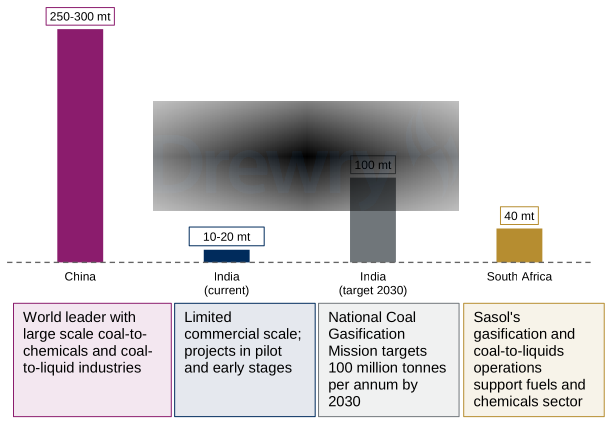
Meanwhile, China remains the largest and most developed example globally. Its coal-to-chemicals and coal-to-liquids industries are estimated to consume around 250–300 million tonnes of coal annually, equivalent to 5–7% of the country’s total coal consumption. Around 70% of China’s methanol production and nearly 80–90% of ammonia production is coal-based. This has supported both domestic coal movements and imports of higher-quality coal required for blending and industrial applications.
South Africa is another important example. Sasol’s coal gasification and coal-to-liquids operations have, for decades, been a key part of the country’s fuel and chemicals sector. South Africa is estimated to gasify more than 40 million tonnes of coal annually, primarily for the production of synthetic fuels, chemicals and industrial feedstocks. While the model was initially developed to reduce dependence on imported oil, it also demonstrated how coal gasification can create long-term industrial demand for coal beyond electricity generation.
Figure 1: Coal used in gasification and coal-to-chemicals industries (million tonnes/annum)
Source: Drewry Maritime Research
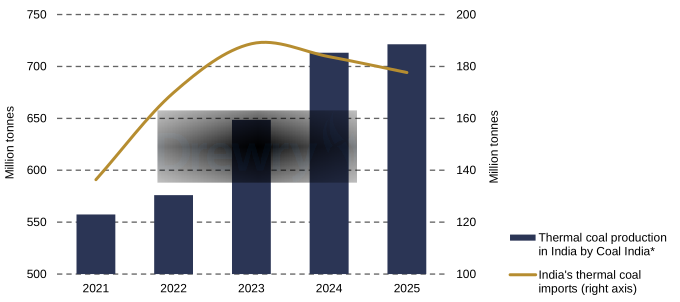
India is now attempting to develop a similar coal gasification ecosystem. Although domestic coal production has risen steadily in recent years, coal imports have remained relatively resilient, highlighting the continued dependence on imported higher-quality coal despite rising domestic output. This becomes particularly relevant for coal gasification because domestic Indian coal presents significant technical challenges, including high ash content, high moisture levels, variable calorific values and large volumes of coal fines, all of which reduce gasification efficiency. Earlier Indian gasification projects struggled because imported technologies were not adequately suited to domestic coal characteristics.
Figure 2: India’s thermal coal imports remain stable, even though production has increased over the years
* Coal India's production data is for the financial year.
Source: Drewry Maritime Research, CIL
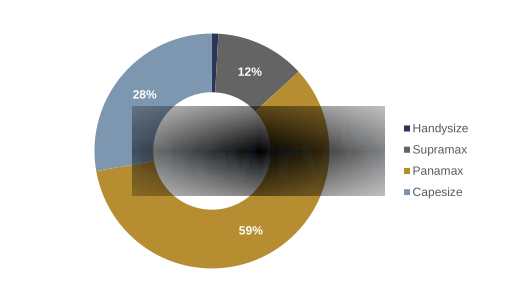
As a result, future projects are likely to require blending with imported low-ash coal to optimise gasification performance, supporting incremental imports from Australia and South Africa. From a dry bulk shipping perspective, this is particularly relevant because India’s coal imports are largely transported on Panamax vessels, followed by Capesize vessels, with a smaller share on Supramax vessels. Therefore, any increase in imported blending coal demand linked to gasification projects could provide additional support primarily for the Panamax segment, while also benefiting Capesize demand on long-haul coal routes.
Conclusion
Overall, coal gasification is unlikely to become a transformational driver of global coal demand as thermal power once was. However, it could gradually emerge as an important secondary pillar of coal consumption, particularly in countries seeking greater energy security and industrial self-reliance. In dry bulk shipping markets, the significance lies less in outright coal volume growth and more in the changing nature of trade flows, including rising demand for higher-quality blending coal, shifting tonne-mile dynamics, and evolving cargo patterns linked to chemical and gas substitution. If India succeeds in scaling its coal gasification ambitions over the coming decade, the impact may be felt not only across domestic industrial sectors but also across global coal and dry bulk trade routes.
Return to...
Related Content
Key Contacts




© Copyright 2026 | Drewry Shipping Consultants Limited. All Rights Reserved. Website Terms of Use | Privacy Policy