
 close
close

We've brought all our trackers and market indices together in a single hub page. Please Register and Login to access this free content.


China’s LPG imports to face the brunt in a second trade war scenario
US LPG accounted for half of China’s imports in 2024 with the US-China trade accounting for 30% of US LPG and 55% of US ethane exports. However, the trade between the two countries has come under the radar with Trump’s re-election and threats of a second tariff war. In 2019, China’s PDH capacity was 6.6 mtpa which rose to 22.6 mtpa by September 2024. With trade dynamics of 2024 contrasting with those of 2019, these tariffs could impact LPG and petchem markets at a different level and scale.
Evolving US-China LPG trade
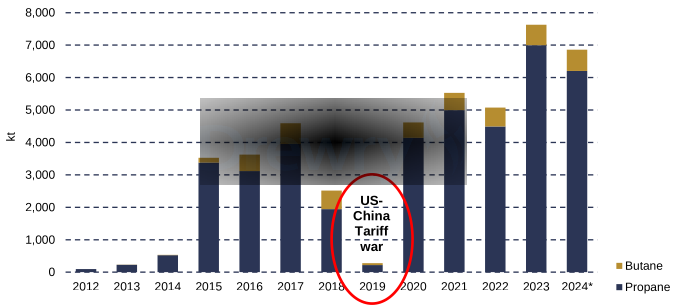
As discussed in our latest LPG Forecaster, the US-China LPG trade, which surged in 2015, driven by the shale gas revolution in the US and expanding propane dehydrogenation (PDH) capacity, faced a major setback in 2019 due to the tariff war between the two nations.
The relaxation in tariffs in 2020 marked a turning point in the US-China trade relations. US LPG exports to China surged to half of China’s total imports in 2024 with the trade contributing around 30% to the total US LPG exports.
A second trade war?
However, Trump’s re-election and his proposed imposition of tariffs up to 60% on Chinese goods and likely retaliation by China could escalate tensions, adversely affecting LPG trade.
Direct Impact:
Such tariffs would likely reduce China's propane imports from the US. Propane is a key feedstock in propylene production, which is crucial for plastic manufacturing. The possibility of the new tariffs has already ruffled the feathers of Chinese buyers for 2025 and they are shifting their term-contracting towards the Middle East.
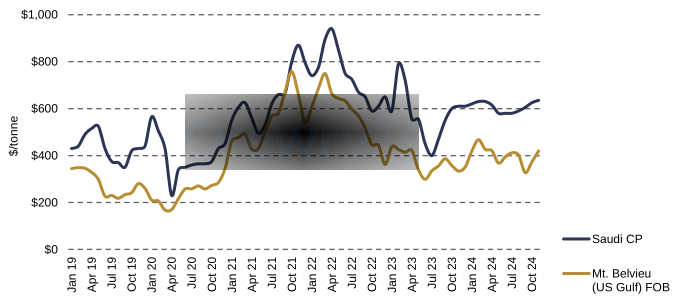
However, replacing US supply will be a lot tougher this time around as China will have to pay hefty premiums to attract the limited Middle Eastern supply, ballooning their procurement costs. The spread between US Mt. Belvieu and Saudi CP propane averaged $205 per tonne, which is likely to rise further if the tariff war starts.
China’s petchem sector is currently reeling under constant negative margins (since April 2023) and will find it tough to absorb the added cost of more expensive Middle Eastern supply. Furthermore, the tariff pressure will also be felt in the downstream markets, which will impact the operating rates at Chinese petchem units.
China’s rapid PDH expansion since 2019 from 6.6 mtpa to 22.6 mtpa in 2024 has also increased the country’s propane demand. Therefore, a fall in operating rates at these units will likely result in a drastic reduction in China’s 2025 LPG imports.
Indirect impact:
China’s diversion of Middle Eastern cargoes at a premium is expected to compel other Asian buyers like India, Japan and South Korea to move towards the US, but apart from India, other countries like Japan and South Korea showcase limited capacity to absorb this excess supply. Meanwhile, we expect the US to also push its exports to Europe, North Africa and South America but again, the scope will be limited.
The trade war will also impact petchem expansion in China, and possibly LPG production and export projects in the US. For instance, three PDH units are scheduled to start in China in 2025 which could get delayed while future project development may face added hurdles in an oversupplied market. These units may also find it difficult to obtain government approvals.
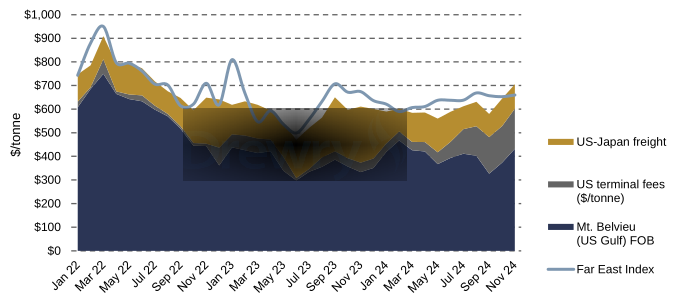
Meanwhile, US is expanding its LPG production and export infrastructure but there might be delays if demand weakens. US LPG terminals are nearing their full capacity with exports supported by a wide arbitrage and record-high NGL production. However, this has led to high terminal fees which in the long run, could impact US exports. Throughout 2024, these fees have increased significantly, now constituting a major portion of the total shipping cost from the US, further complicating the trade dynamics.
We will discuss the trade impact in detail in our next LPG Forecaster.
Companies in the US such as Energy Transfer, Enterprise Product Partners have announced expansions at their current terminals with build-up of associated NGL production infrastructure. However, these expansions could be delayed or put on hold.
Conclusion
We believe there is little possibility of a full-out retaliation by China as the country has been increasingly dependent on US supply courtesy of the expansion of the latter’s PDH sector. Furthermore, lower LPG consumption by China’s residential sector will diminish butane demand, favouring higher propane cargoes from the US. Swapping of contracted Middle Eastern cargoes will also prove to be difficult, leading to supply chain challenges.
Given the growing inter-dependence in LPG trade between US and China, amid the expanding NGL production in the US and increasing PDH capacity in China, any potential escalation of the tariff war could significantly impact the global LPG trade. This would alter the established trade routes, with China shifting its imports towards the Middle East and the US diversifying its export destinations to Europe and North Africa.
Such changes would reduce the tonne-mile demand for LPG shipping, exacerbating the downward pressure on VLGC rates, which have already felt the brunt of vessel oversupply. With 14 more VLGCs expected to join the fleet by December 2025, the market could face further challenges.
Refer to Drewry OnDemand for more such opinions on LPG shipping.
Return to...
Related Content
Key Contacts




© Copyright 2026 | Drewry Shipping Consultants Limited. All Rights Reserved. Website Terms of Use | Privacy Policy