
 close
close

We've brought all our trackers and market indices together in a single hub page. Please Register and Login to access this free content.


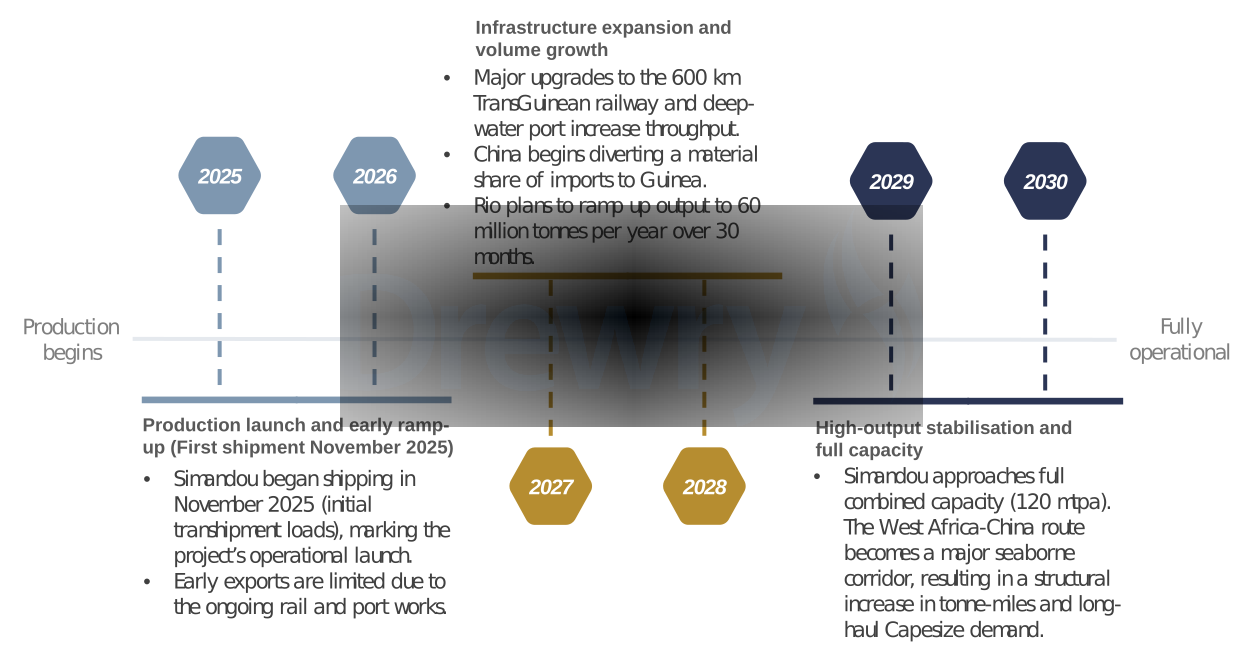
Commencement of operations at the Simandou mine unlocks a new era of long-haul iron ore flows
The emergence of the Guinea–China long-haul iron ore trade will structurally support global Capesize demand, supporting freight rates across all major routes and creating one of the strongest tonne-mile expansions in recent dry bulk history. It will also help China to reduce its reliance on Australia to some extent.
Simandou is one of the world’s biggest and highest-grade iron (65% Fe content) ore deposits, located in southeast Guinea. The first iron ore shipment from the Simandou project was shipped in November 2025. The ore was transported from the SimFer mine via the newly constructed Trans-Guinea railway to the Morebaya port, one of the key export facilities built as part of the Simandou project, and loaded onto a bulk carrier for shipment to China.
Simandou is divided into two zones: Blocks 1-2 are operated by the China-aligned WCS consortium and have a reserve of 1.8 billion tonnes, while Blocks 3-4 are led by the Rio Tinto-Chalco joint venture, having reserves of 1.5 billion tonnes, with Guinea holding a 15% stake. Although Rio Tinto is a major partner in the southern blocks, Chinese entities collectively have the largest strategic influence across the entire project through both mine ownership and shared control of the rail-port infrastructure. China is the largest combined strategic stakeholder across all four blocks.
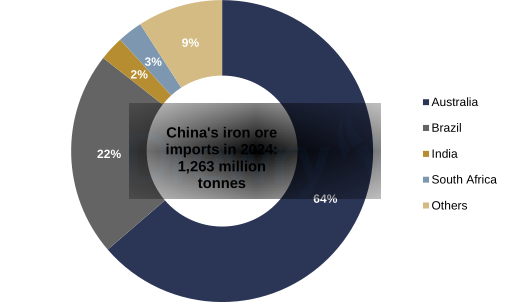
China’s shifting iron ore import strategy
In Brazil, Vale supplies more than 80% of the country’s iron ore and has shipping arrangements with COSCO and other Chinese companies. Therefore, a spike in iron ore imports from Guinea is unlikely to cause a decline in the iron ore trade on the Brazil-China route. Since China is involved in Guinea's iron ore investment, most of the Guinean iron ore is likely to be exported to China. Meanwhile, China’s political relations with Australia have been strained, and it is more probable that a rise in Guinea’s iron ore supply will prompt Chinese importers to shift away from Australia to Guinea, boosting shipping demand.
Figure 2: Australia has the long-standing dominance in China’s iron ore market
Source: Drewry Maritime Research
Additionally, high-Fe content iron ore provide the high-grade input required for low-emission steel, making it crucial for the global green steel transition.
DRI-EAF and hydrogen-based steelmaking needs DR-grade ore (67%+ Fe), but such ore is extremely scarce, and only a small share of the global seaborne market meets this threshold. Without high-grade ore, green hydrogen DRI cannot scale. Net-zero pathways (2050) call for a major shift from blast furnaces to DRI-EAF. The structural shortage of DR-grade projects makes high-grade deposits such as Simandou (65% Fe, near DR-grade) strategically critical for green steel.
With trade routes getting longer, Capesizes get stronger
Assumption: A spike in imports from Guinea will lead to an equivalent decline in China’s iron ore imports from Australia.
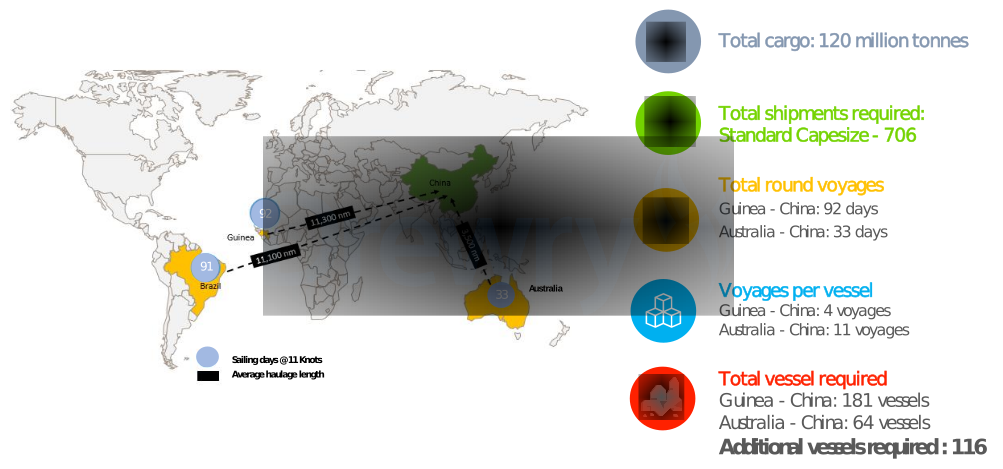
The shift in iron ore trade flows from Australia-China to Guinea-China will boost the vessel utilisation of Capesizes. Once Simandou reaches its targeted 120 million tonnes of annual exports, most likely by 2030, the Guinea-China route will require almost 180 Capesizes compared to 64 vessels needed to transport the same volume from Australia due to the significantly shorter sailing distance. The Guinea-China round voyage is more than 90 days, almost three times the 30-35 days Australia-China rotation.
As a result, each Capesize operating on this route completes fewer voyages per year, increasing vessel demand for the same volume of trade. This shift in trade will lead to a net demand of 116 additional Capesize vessels, representing one of the largest single tonne-mile expansions anticipated in the dry bulk sector in this decade.
Figure 3: Longer-haul trade flows to strengthen Capesize utilisation
Source: Drewry Maritime Research
Although the freight rate between Australia-China is one-third compared to Guinea-China, making Guinea’s ore seemingly more expensive, China is still likely to prioritise sourcing from Guinea. This is because Guinea will supply high-grade, low-impurity iron ore (65% Fe), a similar edge that Brazil has, compared to Australia’s predominantly 59–61% Fe ores, which requires more blending to meet the required quality standards.
Consequently, the shipping cost structure of Brazil and Guinea will be broadly comparable, and once Simandou reaches full-scale production, its cost curve is expected to be similar to Brazil (if not low). Moreover, China’s objective of diversifying away from Australian supply, combined with its massive investment in Guinea’s rail and port infrastructure, makes economic and strategic sense.
This will push charter rates up on major routes and not only on West Africa-China, as fewer ships remain available for flexible deployment. Overall, the development of Simandou will create a structurally stronger Capesize freight market, with strong earnings across global routes for years to come.
Figure 4: Spot rates on major ore routes ($/tonne)
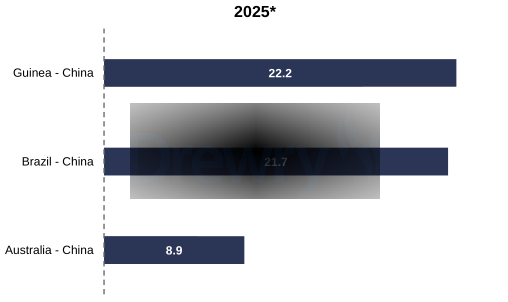
* YTD average.
Source: Clarkson’s, Drewry Maritime Research
Conclusion
Simandou’s emergence marks a fundamental reshaping of long-haul iron ore trade flows, creating a structural uplift in global Capesize demand and supporting freight markets for the rest of the decade. Its high-grade ore also aligns with China’s decarbonisation path, reinforcing its strategic value.
Return to...
Related Content
Key Contacts




© Copyright 2026 | Drewry Shipping Consultants Limited. All Rights Reserved. Website Terms of Use | Privacy Policy