
 close
close

We've brought all our trackers and market indices together in a single hub page. Please Register and Login to access this free content.


Could the Handysize fleet begin to contract?
The Handysize segment, long regarded as one of the most resilient and flexible sectors within the dry bulk shipping, is facing a structural shift. Unlike larger vessel segments, which have historically experienced cyclical corrections in fleet growth and demolitions, the Handysize market has benefited from longer vessel lives, stable replacement tonnage, and the commercial adaptability of its fleet across regional and minor bulk trades. However, the current fleet profile suggests that this balance may come under pressure over the coming decade.
As of April 2026, nearly 50% of the global Handysize fleet was over 15 years old, significantly higher than the 33-34% observed across other major dry bulk segments. More importantly, around 18% of the fleet is already over 20 years old, placing a substantial portion of the segment at the upper end of its commercial operating life.
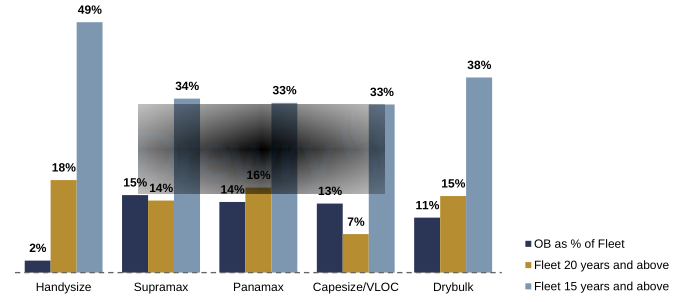
While Handysize vessels historically have longer operating lives than the larger dry bulk segments, with demolition ages often extending between 26-32 years, the scale of ageing tonnage in the fleet is starting to create a structural replacement challenge. Over the next five years, a considerable share of the current 15-20-year-old fleet will move into the 20+ age bracket, while vessels already over 20 years old will approach their likely demolition age.
Figure 2: Average Handysize demolition age (min-max)
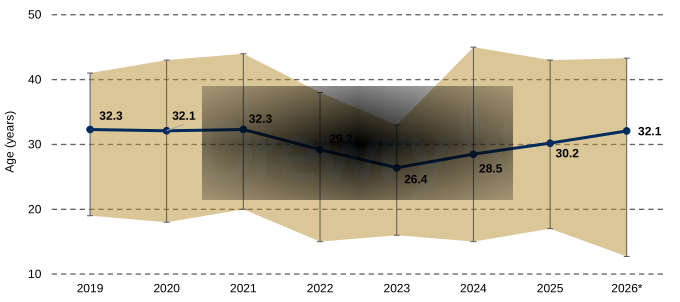
* Until April 2026.
Source: Drewry Maritime Research
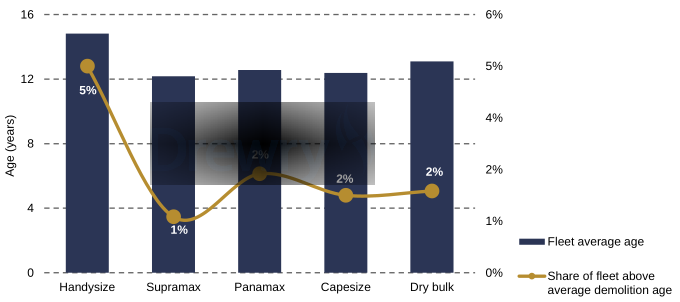
According to Drewry, around 5% of the Handysize fleet is already operating beyond its usual demolition age range, compared to only 1–2% across other dry bulk vessel segments. This highlights the extent to which this segment has historically relied on extending vessel operating lives to sustain fleet availability. Yet the segment’s replacement tonnage is likely to be inadequate over the ageing fleet profile.
The orderbook-to-fleet ratio stands at only around 2%, the lowest among other segments. Scheduled deliveries over the next five years remain insufficient to offset the replacement of vessels approaching their demolition age, let alone support meaningful fleet expansion.
Figure 3: Handysize fleet average age stands at 15 years, the highest among all vessel segments (2026)
Source: Drewry Maritime Research
Over the past few years, the segment has begun to show signs of this supply imbalance. Demolitions have steadily increased YoY, reflecting the growing pressure from ageing tonnage. At the same time, annual vessel deliveries have continued to trend lower, reducing the segment’s replacement capacity.
This imbalance becomes more prominent when viewed against current shipyard capacity constraints. Major Asian yards have seen strong ordering activity across other segments, such as container vessels, limiting near-term newbuilding availability for smaller vessels and the segment’s ability to respond rapidly to market sentiment improvements through fresh ordering. As a result, the Handysize fleet may be entering a period wherein the ageing fleet outpaces replacement tonnage.
The segment’s operational flexibility has allowed older vessels to remain commercially viable for extended periods. Handysize vessels continue to serve regional trades, niche cargo flows, and port-restricted routes where larger vessels remain unsuitable. This flexibility has suppressed demolition activity relative to larger dry bulk sectors.
Drewry believes that maintaining older tonnage may become challenging amid rising drydocking expenses, rising environmental compliance costs and lowering fuel efficiency, gradually increasing the economic burden of operating ageing vessels. At the same time, tightening emissions regulations and growing carbon-intensity requirements could reduce the commercial viability of older vessels long before the end of their actual operating life.
However, this does not necessarily imply that the Handysize fleet will experience an immediate or aggressive contraction. The segment has repeatedly demonstrated its ability to extend vessel lives during periods of supportive freight markets. Strong earnings or improved regulatory clarity could still delay scrapping activity and encourage a new ordering cycle over time.
Conclusion
Nevertheless, according to Drewry, the current supply profile suggests that the segment could struggle to fully replace ageing tonnage over the medium term. If demolitions normalise while new ordering remains structurally constrained, the Handysize market could enter a prolonged period of fleet stagnation or even outright contraction over the next decade.
A more detailed assessment of potential fleet contraction and long-term supply scenarios is available in our Dry Bulk Forecaster, Issue 2, published earlier this month.
Return to...
Related Content
Key Contacts




© Copyright 2026 | Drewry Shipping Consultants Limited. All Rights Reserved. Website Terms of Use | Privacy Policy