
 close
close

We've brought all our trackers and market indices together in a single hub page. Please Register and Login to access this free content.


LNG shipping in 2026: LNG shipping on a ‘road to recovery’, but 2026 marks just the beginning
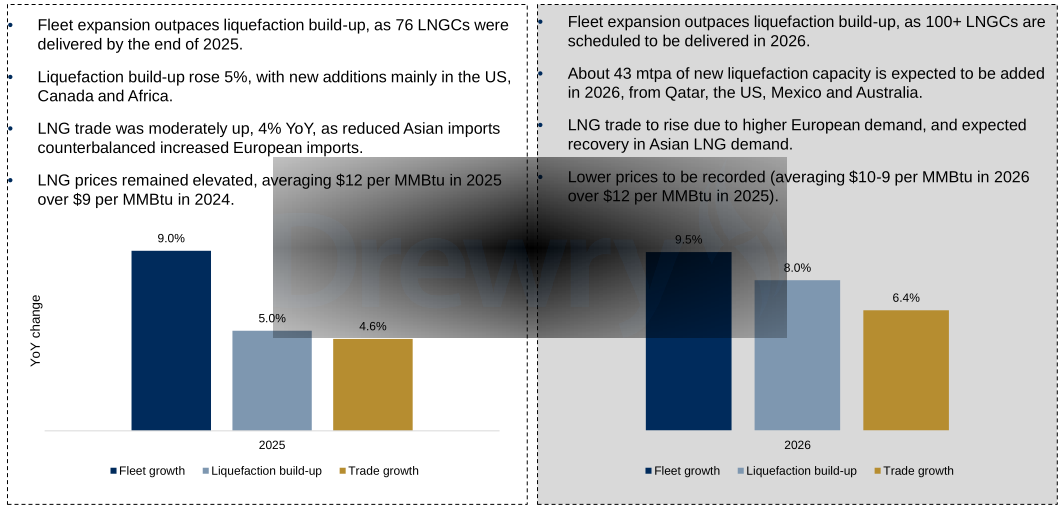
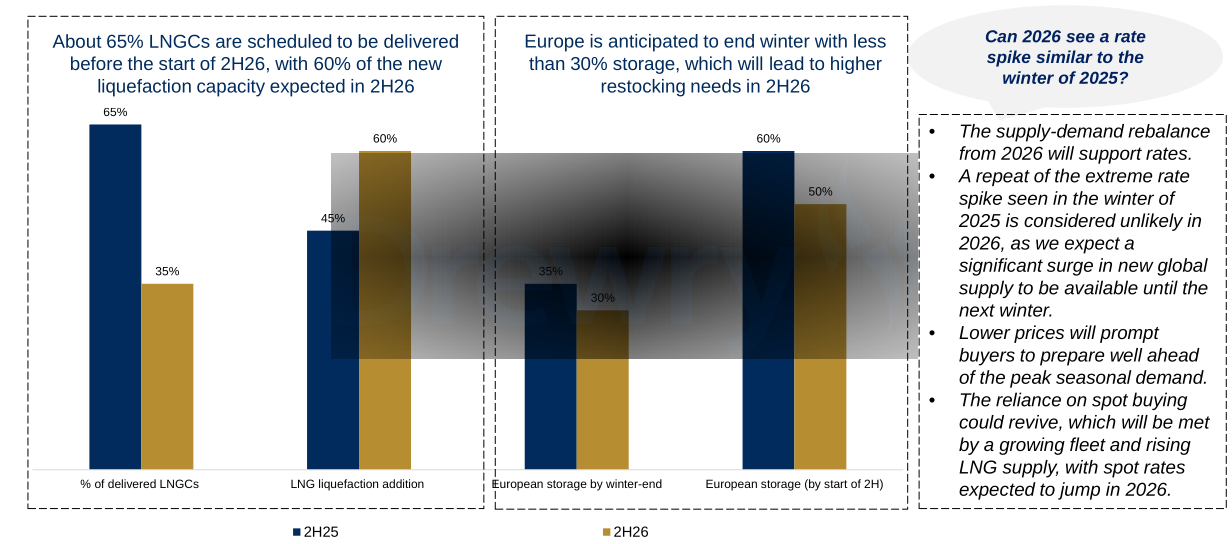
Drewry expects LNG shipping rates to improve in 2026, driven by demand acceleration and LNG supply expansion. However, a significant rebound is still unlikely, as fleet expansion continues to outpace liquefaction build-up. This is highlighted in the 2026 schedule: over 65% of annual deliveries are scheduled for 1H26, while 60% of new supply is expected in 2H26. Although 2026 appears to mark the start of recovery, rising geopolitical tensions in the West have heightened uncertainty and could undermine expectations for this year.
Rates to revive, but rather cautiously, as geopolitical factors and Asian demand could be the wildcards
We expect LNG shipping rates to recover this year from the multi-year lows recorded in 2025 (with TFDE rates averaged $25,000pd in 2025, down 37% YoY, and XDF/MEGI rates averaged $40,500pd, down 25% YoY). Meanwhile, the chances for a strong rebound remain slim, as 100+ LNGCs are scheduled for delivery in 2026, following 76 deliveries in 2025, signalling persistent oversupply.
Although the fleet expansion will continue to prevent any major correction in rates, some positives will serve as catalysts in pivoting rates toward a road of recovery.
Figure 1: 2025 vs 2026
Note: To read a detailed recap for 2025, refer to our previous analysis.
Source: Drewry Maritime Research
LNG trade: Demand will rise, but supply expansion will outpace the demand growth
- Supply growth: About 43 mtpa of new liquefaction capacity is expected to be added in 2026, with some mega projects, including Qatar’s North Field Expansion (16.5 mtpa), Golden Pass T1 (6 mtpa), Corpus Christi Phase-3 and Block2-7 (8.6 mtpa), hitting the market. However, 60% of the upcoming supply is expected to become available in 2H26. Global LNG supply will improve on the back of new production additions (40 mtpa) from 2025, which will ramp up their export intensity.
- Trade recalibration: The demand outlook is bright for Europe, with robust imports expected this year as the continent is likely to end the 2025-26 winter with less than 30% of storage, supporting demand. However, Europe’s quest to implement further structural changes in its energy sourcing (backed by new supply deals and regasification expansion) will be the main driver of imports in 2026.
- Asian demand is set to rise, along with China’s improved demand: Asian demand is anticipated to improve, supported by new supply volumes, higher gas demand, and lower LNG prices. Meanwhile, China’s imports are likely to revive, not due to lower pipeline supply or reduced domestic supply, but to the maxing out of key supply sources that capped China’s LNG demand in 2025. With domestic production already meeting targets for 2025-26 and pipeline supply via PoS 1 operating at full capacity, we expect China’s growing demand to be met through spot buying (which remained subdued in 2025), while new contractual supply is set to commence in 2026.
The fleet expansion will continue; new orders and demolitions to surge
About 100 vessels (including 85 LNGCs) are scheduled to be delivered in 2026. In 2025, 81 vessels were delivered, including 76 LNGCs, with a 25% slippage rate, as several deliveries were deferred due to weaker earnings and project delays.
The current orderbook stands at 334 vessels (282 LNGCs, 41 LNGBVs, four FSRUs and seven FLNGs), with an orderbook-to-fleet ratio at 40%. We expect the orderbook to be stable in 2026, as recovery in new orders will balance the heavy scheduled deliveries during the year.
We expect ordering to rebound in 2026 with a slew of project-linked vessels in the pipeline. The major themes likely to emerge in 2026 will be around ordering carriers, with a focus on high fuel efficiency and emission standards, as owners seek to ‘future-proof’ their vessels amid regulatory and trade uncertainty.
A record 15 LNGCs were scrapped in 2025, with the youngest being 20 years old. The idle fleet is also likely to expand, with 20–25 steam LNGCs coming off charter in 2026, while the heavy delivery schedule of modern carriers will exert more pressure on older carriers. Accordingly, Drewry expects 18-20 LNGCs to be scrapped in 2026, marking another record year. However, these scrappings will still not be enough to balance the vessel surplus in the market.
Watchful of any great expectations, but picture likely to change from 2H26
We expect LNG shipping rates to strengthen in 2H26 compared to 1H26, as over 70 LNGCs will be added to the fleet, available to cater to the new supply (with over 60-65% of the new liquefaction capacity added in 2H26).
Asian demand is likely to surge towards mid-2026, as the summer of 2026 is projected to be exceptionally hot. With prices easing and supply improving, Asian buyers will increase their purchases, which were mainly constrained by higher prices in 2025. Moreover, Europe is expected to end the 2025-26 winter with less than 30% storage, necessitating higher restocking; this could accelerate in 2H26 as European countries begin preparing for their next winter, entering the second half with about 50% storage (below the five-year average). Europe will strive to sail another winter without Russian gas, and this time it will also have to navigate (possible) new tensions with its most-relied-upon LNG partner – the US. While 1H26 will be driven by an intense summer, 2H26 will be fuelled by a winter restocking.
Geopolitics will remain perilous, with various implications for LNG shipping
Geopolitics will remain a key driver of LNG shipping dynamics in 2026, with global tensions unlikely to ease anytime soon. On the contrary, the year has already begun with renewed US action in Venezuela and the former’s ambition to take over Greenland. While any direct impact on the LNG trade seems unlikely, the ripple effect could derail the expected pace of LNG development.
Meanwhile, the US-China trade war has already exacerbated tensions between the two, and any military confrontation or economic conflict could trigger a rollback of tariffs, sanctions and USTR policy.
Despite easing tensions in the Red Sea, with no attacks being carried out by the Houthis in the last 100 days, LNGC transits via the Suez Canal remain limited. We expect the return to Suez to be gradual for these carriers, as shipowners opt for a ‘wait-and-see’ approach amid prolonged geopolitical tensions. Meanwhile, a persistent vessel surplus in 2026 is likely to support longer voyages via COGH. Moreover, a resolution between Russia and Ukraine appears to be difficult, with Europe considering a full ban on Russian LNG by 2027.
Conclusion
While we expect rates to recover, 2026 will be just the beginning, with demand and geopolitical uncertainty setting the course for LNG shipping. The year will be a turning point for the market, as new supply converges with growing demand. This dynamic is expected to lower costs and strengthen the global LNG market, supported by the completion of mega projects in the US and Qatar. With this, 43 mtpa of new liquefaction capacity is anticipated to be added, following the 40 mtpa already added in 2025. However, evolving geopolitical developments and weather-related challenges will impart short-lived volatility in the market.
“Although we expect a recovery in rates, most of the growth will be recorded in 2H26, as improved demand converges with expanded supply. However, we remain cautious about any significant correction in rates in 2026 as LNG Fleet > LNG supply> LNG Demand”.
In order to get more/detailed insights on the LNG shipping in 2026 and beyond, read our latest LNG Forecaster, released on 9th January. You can also register for our upcoming webinar on 29 January 2026, covering the 2026 outlook and key developments in LNG shipping & market.
Return to...
Related Content
Key Contacts




© Copyright 2026 | Drewry Shipping Consultants Limited. All Rights Reserved. Website Terms of Use | Privacy Policy