
 close
close

We've brought all our trackers and market indices together in a single hub page. Please Register and Login to access this free content.


Rising US LPG trade with India and Indonesia and its impact on shipping dynamics
Global LPG trade flows realigned in 2025, triggered by the US–China tariff standoff, and evolved into far-reaching changes in trade patterns and LPG supply dynamics. As Chinese buyers continued to favour non-US supply, US supplies were redirected to ‘other-Asia’, including India and Indonesia.
Although tensions eased after the November 2025 tariff truce and the ruling by the US Supreme Court, a full return to pre-dispute trade levels appears unlikely, as these exposed structural fault lines from an increasingly interdependent relationship. China has since diversified its imports towards Canada and the Middle East, while the US has expanded its footprint in India and Indonesia.
This trade realignment will support LPG shipping with longer-haul US–India and US–Indonesia voyages lifting tonne-mile demand and tightening vessel supply, thereby supporting LPG shipping rates.
Why the US–India/Indonesia route gained prominence in 2025?
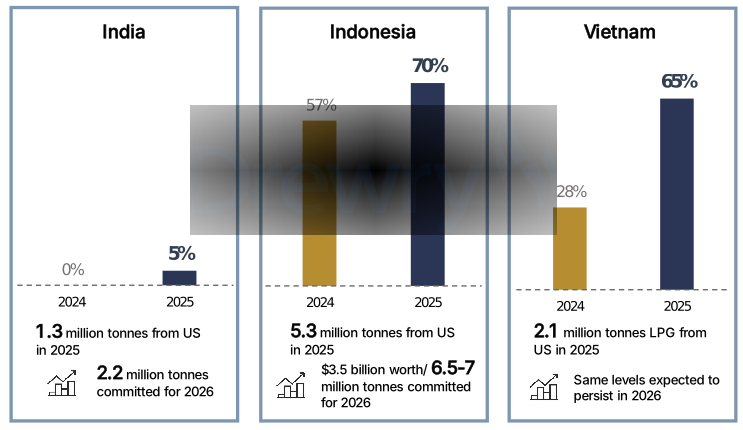
China’s shift towards Middle East and Canadian LPG supply created ripples in the Asian supply mix, pushing other importers towards the US. The rise of the US–Indonesia trade in 2025 was decisive, with 70% of Indonesia’s 7.5 million tonnes of imports sourced from the US. A sharp correction in Mt. Belvieu prices amid tariff uncertainty kept the US arbitrage firmly open, particularly as stronger Chinese buying lifted Middle Eastern cargo premiums over Saudi Aramco CP. While the US’s share in Indonesia’s LPG imports rose over the last few years, the shift has now materialised into a trade agreement.
Recently, Indonesia signed an agreement to purchase $3.5 billion worth of US LPG every year, anchoring long-haul flows from USGC.
The same factors that led to a rise in US share in Indonesia’s LPG imports also drove an increase in US share in Vietnam’s LPG imports. However, India’s shift was more gradual. In 2025, India imported 1.3 million tonnes of US LPG, lifting the US share to 6% from negligible levels in previous years, owing to China’s shift towards Middle East supply. India’s LPG imports from the US are poised to rise further with Indian LPG buyers—IOC, BPCL and HPCL—signing agreements in October 2025 to import 2.2 million tonnes in 2026 from Chevron, Phillips 66 and TotalEnergies, priced against Mt. Belvieu. The cargoes will be even split propane-butane that align with India’s heavy residential demand profile and anchors US–India LPG trade in 2026.
Trade realignment and route changes to support tonne-mile demand
Changing trade patterns and the shift towards longer haul movements, particularly on US–India/Indonesia route, is expected to strengthen tonne mile demand for LPG shipping. Even with the modest global LPG trade growth projections for 2026, the distance effect is set to dominate, allowing tonne mile demand to expand even if overall volumes remain broadly stable.
In 2025, laden VLGC transits through the Panama Canal declined YoY as more vessels diverted to the COGH, extending voyage distances. Further, the introduction of the Long Term Slot Allocation (LoTSA) system at the Panama Canal—requiring operators to secure Neo-Panamax slots through advance bidding—provides transit certainty but at the cost of reduced flexibility.
The mechanism exposes charterers to bid premiums amid volatile arbitrage economics, making it commercially unattractive for spot oriented traders. As a result, a larger share of VLGC traffic is expected to continue favouring the COGH route over Panama.
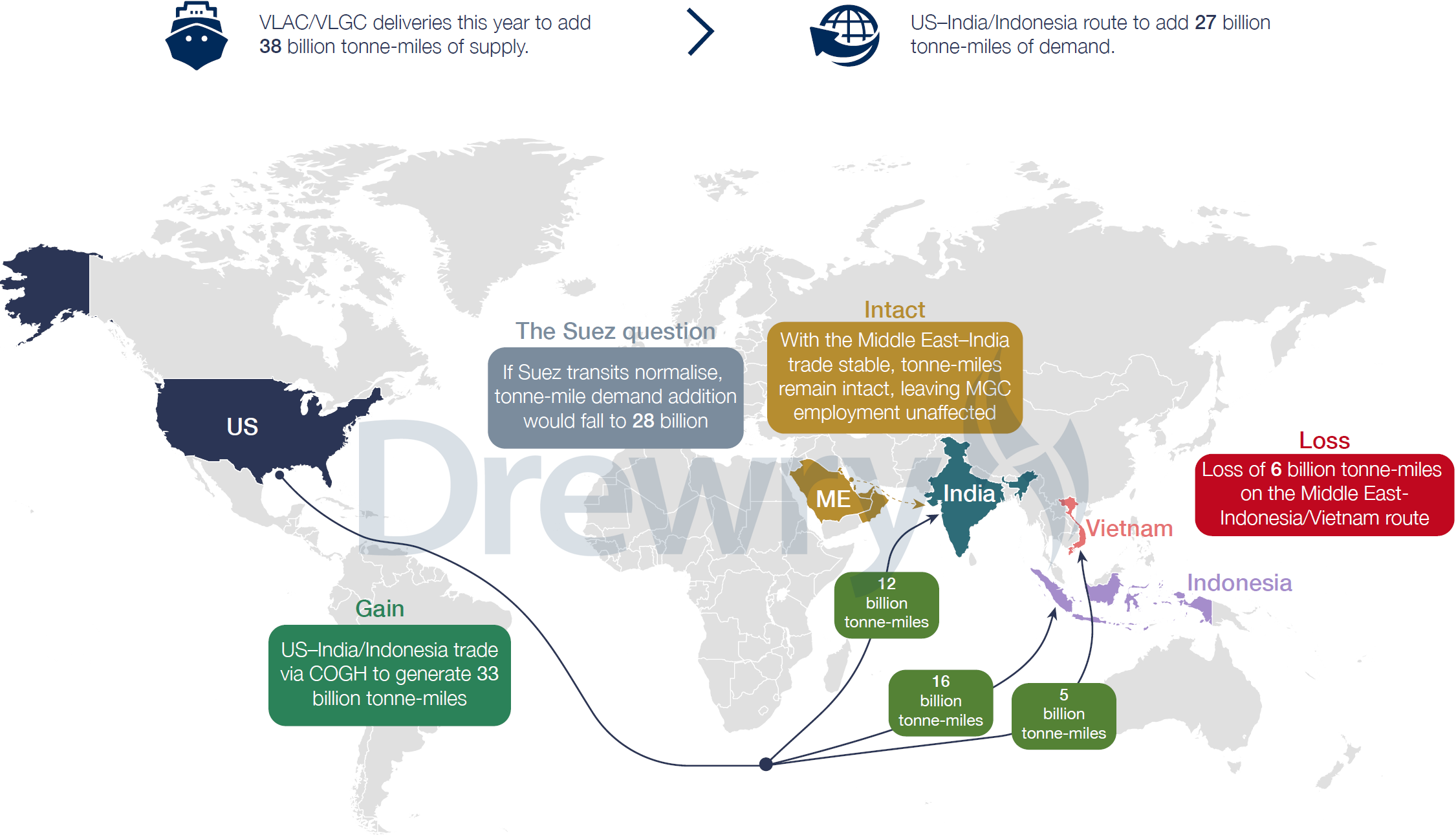
Meanwhile, a recovery in Suez Canal transits is likely to be gradual and contingent on geopolitical developments, limiting downside risks to VLGC tonne miles. However, any normalisation of passage could support Europe–Asia flows on MGCs and LGCs, indirectly tightening competition for cargoes.
Additionally, potential OPEC+ production restraint and ongoing geopolitical risks in the Middle East may cap Middle Eastern LPG supply growth in 2026, reinforcing India’s and Indonesia’s reliance on US exports.
Figure 2: Emerging US–India/Indonesia VLGC trade: A key factor limiting TC rate decline in 2026 despite accelerated deliveries
Source: Drewry Maritime Research
Accelerated VLGC/VLAC deliveries: Can trade absorb the supply wave?
The VLGC market is expected to face significant supply pressure especially as the orders placed during the 2022-24 market upcycle will be delivered amid weak demand conditions. Moreover, the slow progress on clean ammonia trade amid delays and cancellations in planned production capacity will push VLACs to the LPG trade.
On paper, such expansion implies downwards pressure on freight rates. However, we expect VLGC TC rates to decline only marginally YoY in 2026—compared to the scale of deliveries as the US–India/Indonesia trade route extends voyage distance, increases reliance on COGH routing, anchors long-haul US exports into South and Southeast Asia, and provides stable import demand growth from deficit maturing markets. Without these factors, the rate correction could have been significantly sharper.
Implications for Pr segment
The sourcing shift also has knock-on effects for the Asian Pr market. Southeast Asian importers rely on propane–butane split cargoes for residential consumption. With the US committing significant split volumes to India, availability for other buyers may tighten. Concurrently, China is expected to import more butane-rich cargoes from the Middle East. As a result, butane flows are expected to increase in the region, keeping Pr rates on intra-Asia trade routes firm in 2026.
Conclusion
The emerging US–India/Indonesia LPG trade route reflects a rebalancing rather than a temporary diversion. Even if global trade growth remains moderate in 2026, the amplification of tonne-mile demand—driven by longer routes and canal transits—provides an important buffer against fleet expansion.
New deliveries will weigh on the market, but these factors will prevent a sharp erosion in earnings. VLGC rate declines are therefore expected to remain modest, while the Asian Pr segment stands to benefit from tighter split cargo availability and expanding intra-Asia butane trade.
Return to...
Related Content
Key Contacts




© Copyright 2026 | Drewry Shipping Consultants Limited. All Rights Reserved. Website Terms of Use | Privacy Policy