
 close
close

We've brought all our trackers and market indices together in a single hub page. Please Register and Login to access this free content.


Shipbuilding and ship repair yards: Emerging avenues for investment
The rapid growth of newbuilding yards across various countries reflects efforts to support national security, economic growth and strategic autonomy, while the development of ship repair yards globally will mainly serve the increasing retrofit activities1 due to the decarbonisation drive in the industry. In this article, we compare and contrast newbuilding and repair yards through the investment lens.
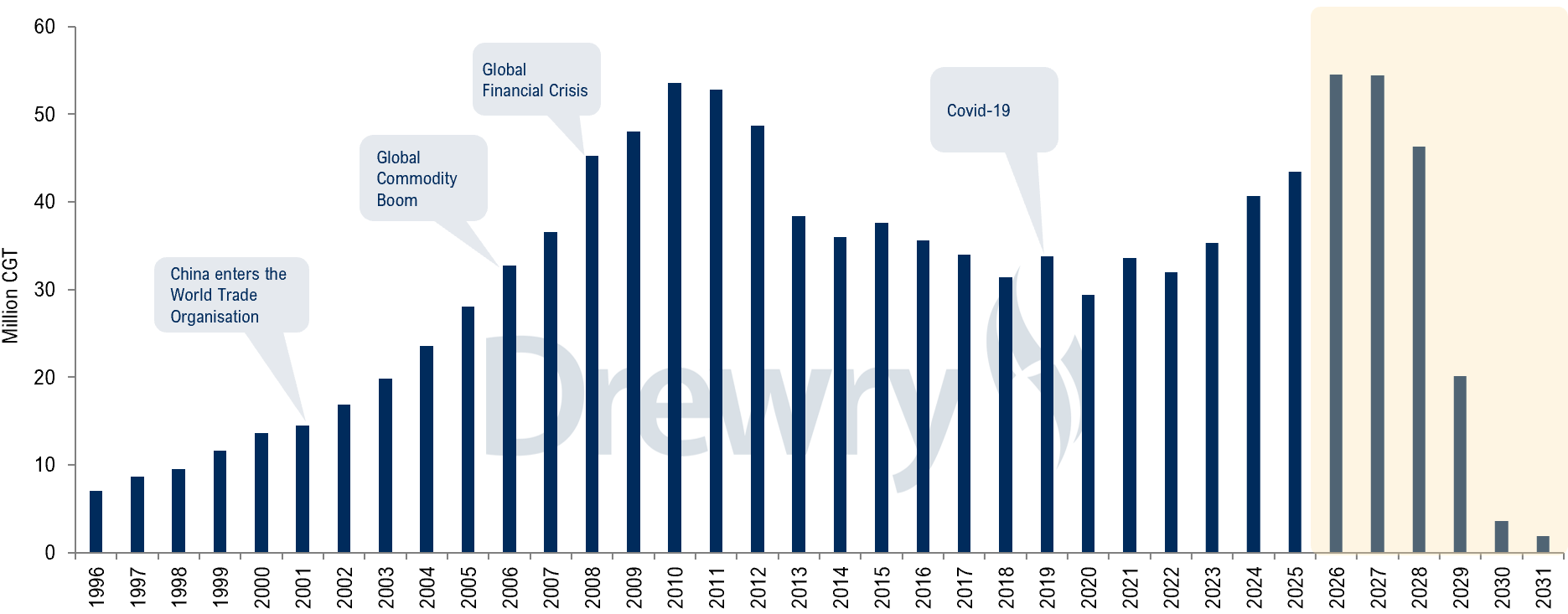
The global newbuilding market peaked in 2010, delivering an aggregate 54 million CGT2 (compensated gross tonnage), but deliveries started declining thereafter due to supply overhang and weak markets across most shipping sectors. The market hit rock bottom in 2020 with 29 million CGT, but it revived post-Covid with a significant increase in container and LNG shipping earnings.
Newbuilding yards
Newbuilding yards create employment in related industries, such as steel manufacturing, engineering service providers and equipment suppliers. This industry is critical to developing long-term national strategies, as it involves the construction of naval ships and is pivotal for supply chain security. The shipbuilding industry is intertwined with the shipping industry. Therefore, it is very cyclical and volatile. The cyclicality, volatility and stiff competition in the industry have necessitated significant government support in the form of subsidies and low-interest long-term loans.
Based on the current orderbook and delivery schedule, shipyards are fully booked for the next three years, which has created shipbuilding capacity constraints. These limitations are leading to capacity expansion in existing shipyards, revitalisation of mothballed yards and commencement of new shipyards, such as Jiangsu New Rongsheng Heavy Industry. Simultaneously, some governments, such as the US, India and Indonesia, have been promoting investments in shipbuilding yards.
Two of the three major merchant shipping sectors, namely dry bulk and tankers, have had a relatively low orderbook (of around 10%-20%) due to weak markets and uncertainty regarding environmental regulations. However, with demand increasing steadily and earnings reviving, we expect orders for new tonnage to also rise, with most of the orders likely for dual-fuel vessels.
Repair yards
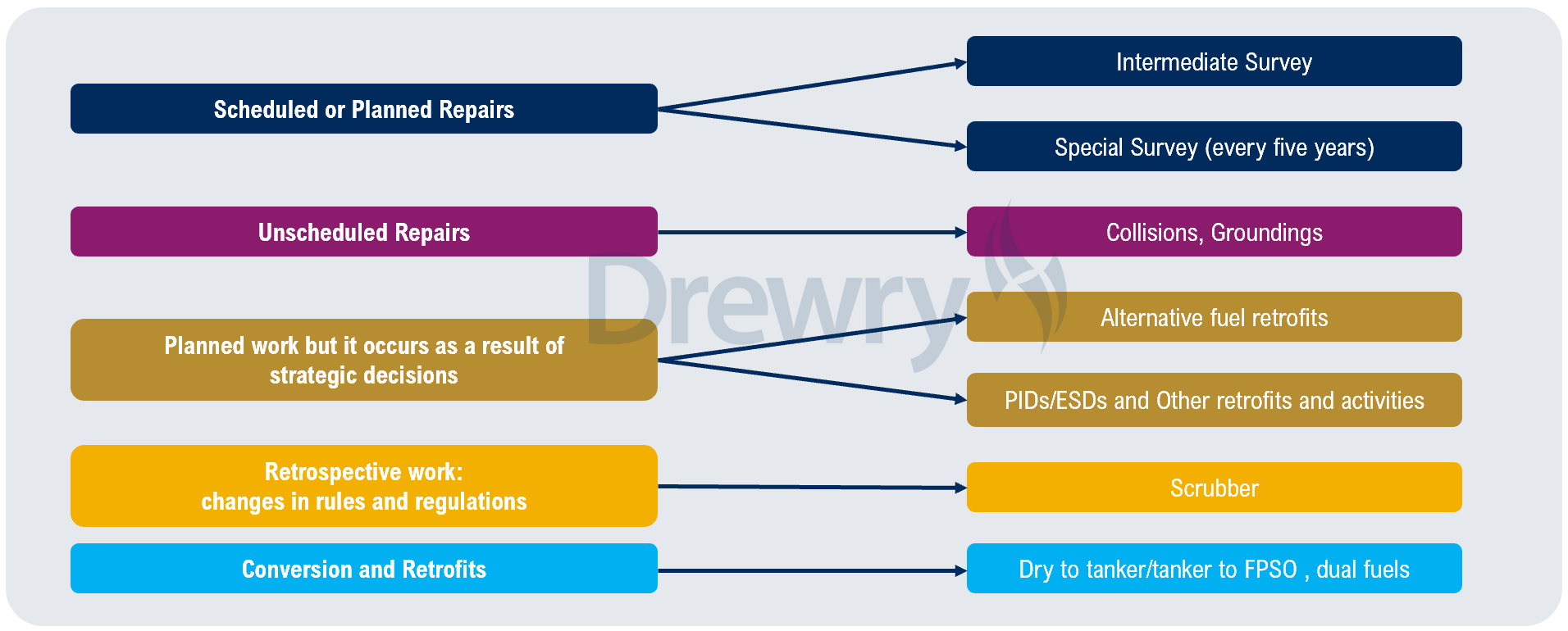
The ship repair market is supported by five key demand drivers, including unplanned or emergency repairs, periodic maintenance, planned repairs due to a shift in strategy, retrofits to comply with regulations, and conversions. Meanwhile, a yard’s competitiveness depends on the type of work it undertakes.
Source: Drewry Maritime Research
As repair yards are less cyclical, the ship repair industry’s gross and operating margins are higher than those of the newbuilding industry. However, in order to handle various activities, repair yards need a more diverse ecosystem, which may include:
- Specialised engineering companies—some of the work is outsourced to these companies
- Efficient procurement of spare parts—the distribution hub of spare parts for major equipment should be near the repair yard
- Efficient custom clearance facilities—required spare parts from overseas can reach the repair yard promptly
- Appropriate transportation systems and international transport connections—this should be available for service engineers and class surveyors travelling to the repair yard from overseas
It is important for repair yards to be near the trade lanes so that vessels can reach them without a significant deviation. This requirement, however, is not important for a newbuilding yard.
Growth of retrofit measures and regulatory timeline
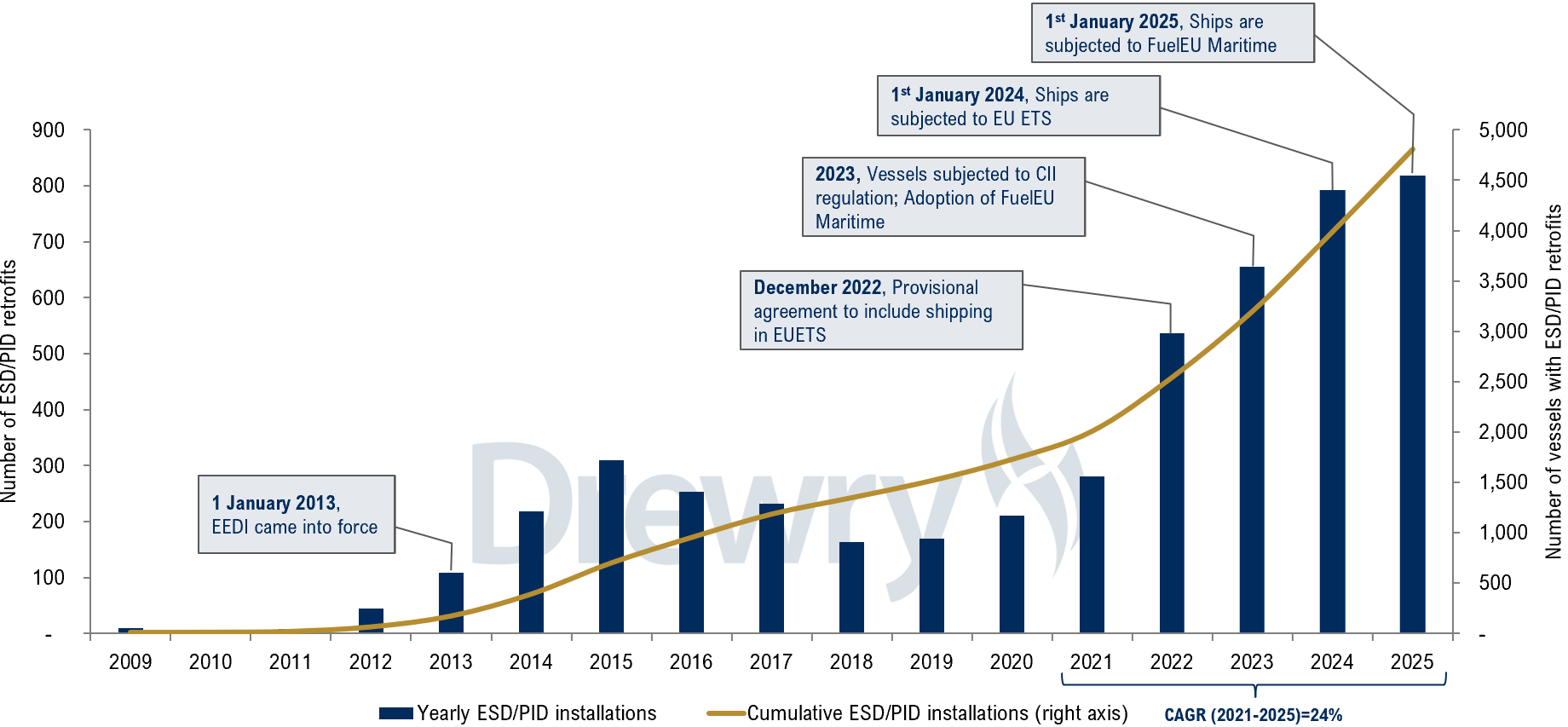
Before the Greenhouse Gas (GHG) reduction regulations3 came into play, the only driver to support the adoption of ESDs or PIDs was to decrease the vessel’s fuel consumption. The GHG reduction regulations introduced additional drivers for the uptake of such technologies. The CAGR (2021–25) for ESD/PID retrofits was around 24%, indicating that regulations have been a major driver of these retrofit activities.
Regulations, such as FuelEU Maritime, encourage dual-fuel vessels (newbuilding as well as retrofitting of existing vessels) and Wind-Assisted Propulsion System (WAPS). Additionally, other conversions, such as vessel lengthening and superstructure modifications, will also increase the demand for repair yards.
Major driver for retrofitting: IMO Net-Zero Framework (IMO NZF)4
In October 2025, the IMO’s Marine Environment Protection Committee (MEPC) decided to delay the adoption of IMO NZF. In case this regulation is adopted soon with no changes to penalty calculations, alternative fuel retrofits and PID/ESD retrofits will ramp up rapidly and exponentially. Drewry believes growth in retrofit measures will be rapid due to various reasons, including the tightening of environmental regulations, a carbon emission penalty and a push for decarbonisation from various stakeholders.
Way ahead
- Dry bulk, tanker and container fleets recorded 6%, 3% and 8% CAGR in the past 20 years, respectively. In the next 10 years, we estimate a CAGR of 2–3% for dry bulk and tankers, and 3–5% for containers, increasing the demand for shipbuilding yards.
- We expect demand to increase for advanced technological measures, such as Onboard Carbon Capture and Storage (OCCS), WAPS and dual-fuel engine retrofits.
These and other PID/ESD retrofits will boost the demand for repair yards, creating fresh avenues for investment.
1 Such as energy-saving devices (ESDs), propulsion-improving devices (PIDs), dual-fuel retrofits and others.
2 CGT stands for Compensated Gross Tonnage, a specialised unit of measurement developed to accurately reflect the amount of work—specifically manhours and complexity—required to build a particular vessel. It is a measurement of shipbuilding volume.
3 Such as the European Union Emission Trading System (EU ETS) and FuelEU Maritime.
4 Despite the delay in adopting the IMO NZF, the 2023 IMO GHG reduction strategy, the Carbon Intensity Indicator (CII) measure, regional regulations, internal decarbonisation targets of major shipping companies and demand from stakeholders, including banks, will continue to drive the utilisation of repair yards.





© Copyright 2026 | Drewry Shipping Consultants Limited. All Rights Reserved. Website Terms of Use | Privacy Policy