
 close
close

We've brought all our trackers and market indices together in a single hub page. Please Register and Login to access this free content.


Shrinking lifeline for steam LNGCs — Are TFDE/DFDE carriers next?
Drewry expects about 25% of the total vessel demand to be for replacement tonnage by 2035. While over 550 LNGCs will be required by 2035, 140 LNGCs will be needed to offset the tonnage lost from accelerated demolitions. We expect 100 steam turbine carriers to be scrapped by 2030. In the wake of increasingly stringent regulations, TFDE/DFDE carriers could be the next to feel the heat, especially if there are no technological advancements to address their existing issues.
Steam carriers are bearing the brunt of increasing scrutiny and rising market uncertainty
Several steam turbine carriers are coming off charter and have limited employment opportunities. Moreover, the continued rate crash for steam vessels coincides with growing economic and environmental infeasibility, leaving many of these open carriers idled or laid up as re-employment opportunities remain challenging, while deliveries of modern carriers are at record highs, keeping supply ample.
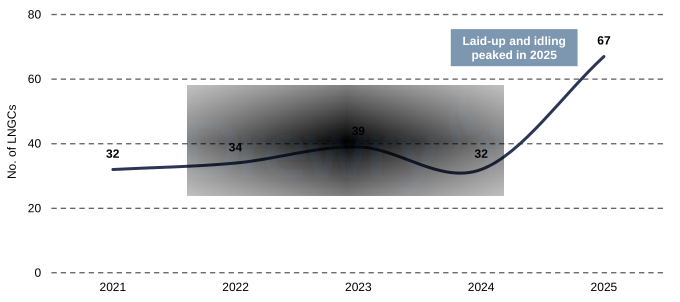
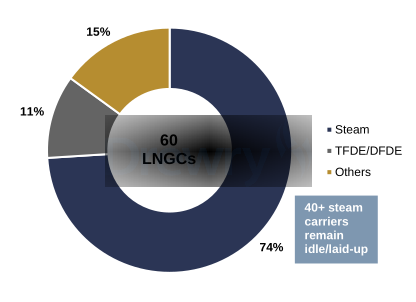
As of February 2026, over 60 LNGCs are idled/laid-up, of which steam carriers account for 70% of the total. Some owners are placing their ships in lay-up, hoping that the vast liquefaction capacity expected towards 2028-29 will generate demand, whereas charters will likely become more reluctant to deploy steam carriers, as this will incur substantial costs. Meanwhile, an influx of modern carriers is underway.
Although we expect the market to rebalance in 2026 as supply-demand fundamentals improve, demand for steam carriers will remain low, leading to another year of record-breaking demolitions. Meanwhile, even after laying up the ships for three to four years (with laid-up costs depending on their condition), vessels might only get a short burst of employment, leaving vessel owners to bear the cost.
Figure 3: Steam carrier: Charter rates at record low, with rising cost burden
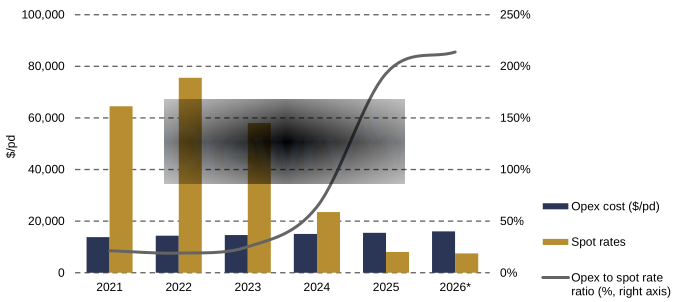
* 2026 is an estimation based on our forecast for steam carriers.
Note: Ship operating cost is considered from Drewry's Ship Operating Costs 2025 Annual report.
Source: Drewry Maritime Research
As charter rates are falling and operating costs are rising (though steadily), the ratio between the two has been widening since 2025; we expect the same trend to continue in the coming year, challenging the economic viability of these carriers. No savings appear plausible for these carriers under normal market conditions, leaving several steam carriers stranded as a result of a dismal demand outlook.
Higher demolitions to create demand for over 80 new LNGCs by 2030
We anticipate an average 18-20 carriers to be demolished each year through 2030 (with scrapping peaking in 2028-29), which will necessitate demand for new LNGCs. According to our estimates, about 80 LNGCs will be required to balance replacement tonnage through 2026-30.
Figure 4: Demolished vessels v/s replaced demand for LNGCs
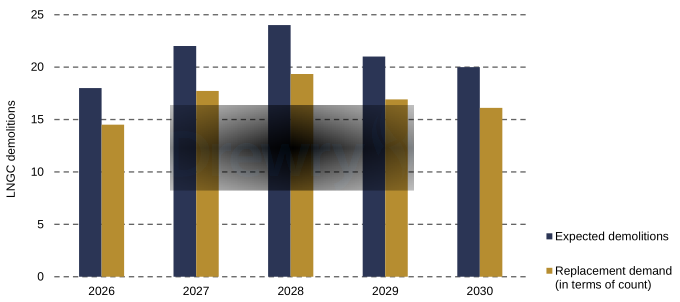
Note: Estimation for vessel demand only considers expected demolitions per year (though some could end up for conversions).
Source: Drewry Maritime Research
LNG fleet at risk
Figure 5: Share of LNG fleet based on engine-technology type
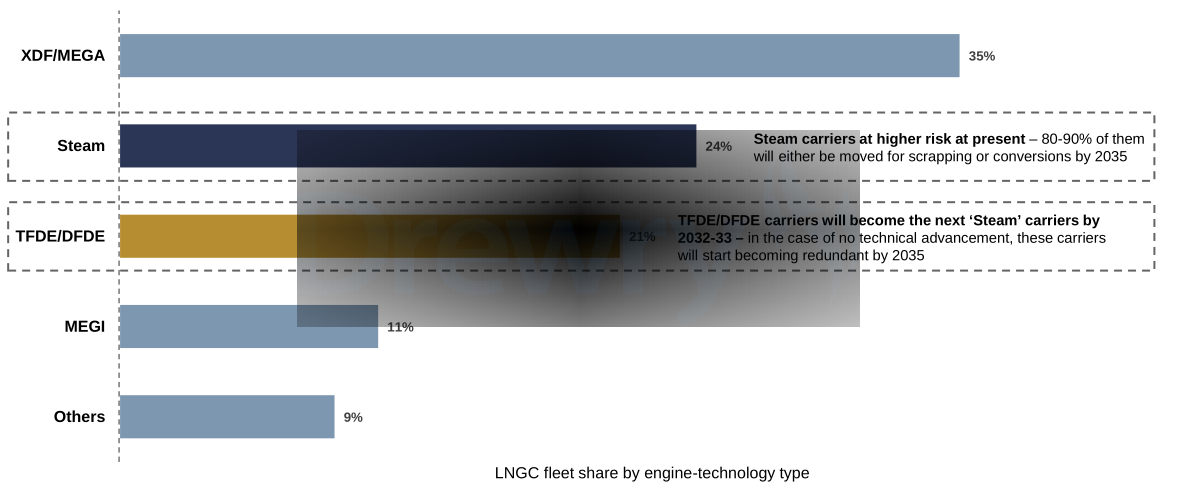
Note: Risk category as per market conditions, charter rates, OPEX cost, charter duration, and environmental and economic feasibility, and regulatory conditioning.
Source: Drewry Maritime Research
Will TFDE/DFDE carriers be next in line?
As maritime regulations become more stringent and non-compliance increasingly challenging, we expect TFDE/DFDE carriers to bear the brunt in the long run, especially if technological reforms fail to address existing inefficiencies and push them to scrapyards.
Demolitions of these carriers will hinge on multiple factors, including: 1) stricter regulations on methane slip, undermining the feasibility of these carriers, 2) technological breakthroughs failing to keep pace with regulations, 3) the number of LNGCs available by 2030, 4) the cost differential between opex and charter rates, and 5) market conditions amid growing geopolitical uncertainty.
About 20% of the current TFDE/DFDE LNG fleet will be at risk as regulations become stricter over time, affecting the commercial viability of these vessels. However, as Asia will be the main growth hub for LNG trade, we can expect more of these vessels to find employment there. Nevertheless, they will steadily lose their economic and environmental viability, ultimately being relegated to the scrapyards. While demolitions will be gradual, the phasing out will necessitate a greater demand for more efficient carriers—a journey seen for steam carriers will be followed by TFDE/DFDE carriers.
Figure 6: LNGC Demolitions: TFDE/DFDE carriers to start feeling the heat post-2030
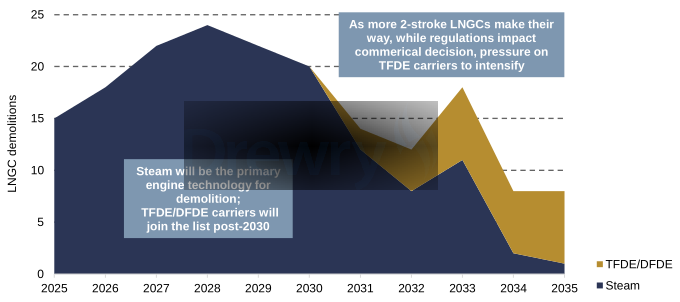
Source: Drewry Maritime Research
More LNGCs will be required by 2035
Drewry projects that over 550-600 LNGCs will be required by 2035, driven by project-linked vessel demand and replacement tonnage from demolitions. We expect new orders to rebound in 2026 and 2027, primarily to meet the demand from upcoming LNG projects. However, as demolitions accelerate, the demand for replacement tonnage will follow suit, boosting the demand for new carriers.
Conclusion
LNG shipping is expected to undergo a massive transformation as growing regulatory stringency chokes out less-efficient carriers in a highly regulated market. While steam carriers are and will remain under threat, with over 100 carriers expected to be demolished by 2030, this will generate demand for about 75-85 vessels. The growing scrutiny of maritime regulations could pose a risk for TFDE/DFDE carriers too, which account for 20% of the current fleet. We expect, with this, an aggregate demand of 135-145 LNGCs could be generated by 2035, primarily driven by the accelerated demolition of steam carriers, followed by the gradual scrapping of TFDE/DFDE carriers post-2030.
Note: The projected vessel demand is based solely on expected demolitions per year (for the period 2025-35). Potential demolition candidates could also secure conversion opportunities, or any technical advancement for the TFDE/DFDE engine could extend the life expectancy of those carriers.
Return to...
Related Content
Key Contacts




© Copyright 2026 | Drewry Shipping Consultants Limited. All Rights Reserved. Website Terms of Use | Privacy Policy