
 close
close

We've brought all our trackers and market indices together in a single hub page. Please Register and Login to access this free content.


Middle East on fire: Implications for VLGCs
The escalating armed conflict in the Middle East has transformed the shipping sector’s worst nightmare into reality—the “technical” closure of the Strait of Hormuz—on 28 February 2026.
Further military escalations are likely in the region, which has forced commercial shipping to suspend operations, with vessels now stuck in the Persian Gulf and others turning away from the Strait of Hormuz. The sudden change in insurers’ war risk policies will also keep ships away from the passage until the tensions ease.
Given the Strait of Hormuz’s high importance to energy shipping, Drewry presents its views on the short-term implications of the Strait closure on vessel movements, commodity supply and demand reactions.
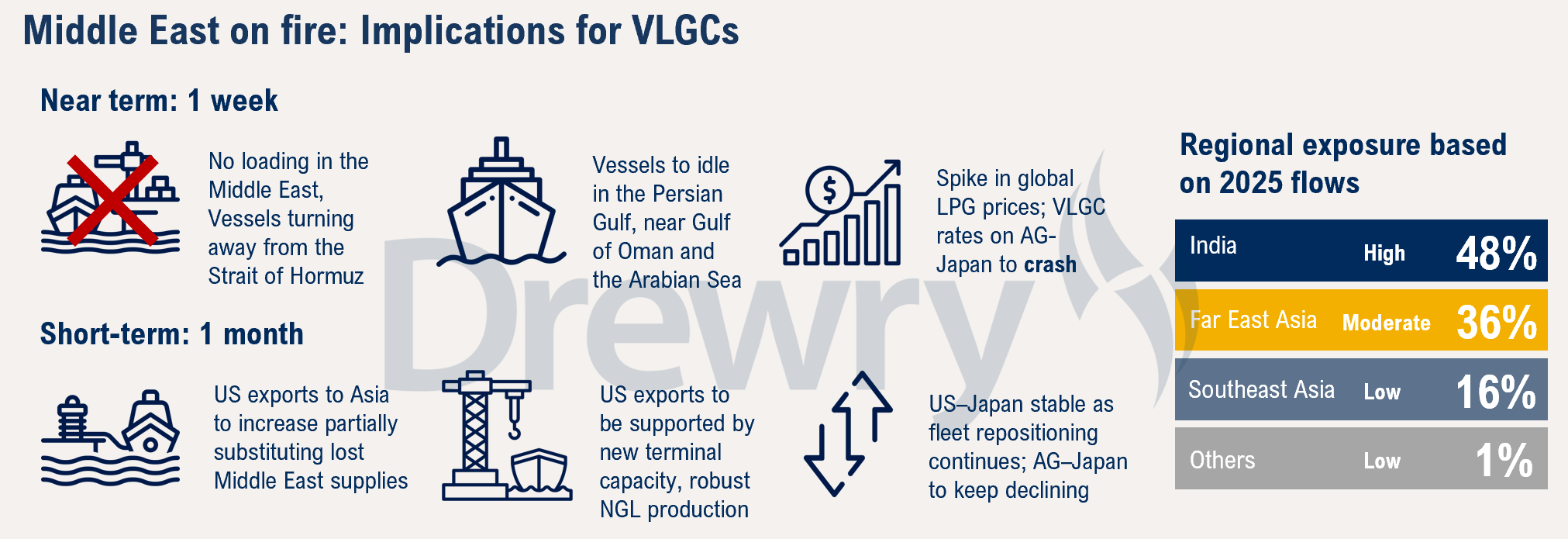
Source: Drewry Maritime Research
Situation now
- The IRGC has issued warnings that navigation through the Strait of Hormuz is prohibited, with mixed news on its official closure.
- Crude, LNG and LPG ships are currently stranded inside the Gulf and unable to exit. Mass GPS jamming and AIS spoofing noted.
- Ballast ships heading to the Middle East are seen idling near Oman (Arabian Sea) or making U-turns from the Strait of Hormuz towards the COGH.
- Houthi in Yemen have announced the resumption of vessel attacks, increasing the risk to Suez Canal transits.
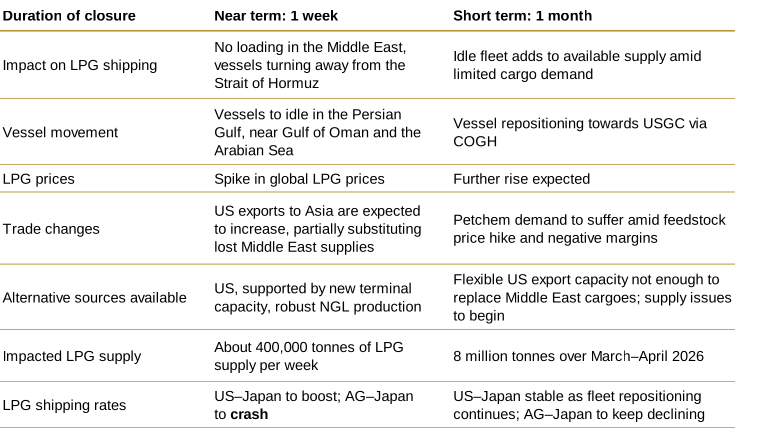
Nearly 40% of global LPG supply passes through the 34 km narrow passage annually, directly impacting importers such as India and China, which depend heavily on Middle East LPG supplies. We envisage VLGCs near the Strait (at the moment) to be idled or moved to safe positions. Sustained blockade of the passage will prompt vessels to reposition to the US, where new terminal capacity and robust NGL production can support higher exports.
The ballasting of vessels will create a short-term squeeze in vessel availability, triggering volatility in rates. However, we expect vessel availability to rise in the US Gulf, which, along with the sustained Hormuz blockade, would limit cargo availability and weaken rates.
Given the immense importance of the passage for energy exports, major Middle Eastern countries will be keen to open it at the earliest. Even a slight resolution could lead to partial reopening of the corridor, with possible Naval convoys. However, the expected rise in military action and potential use of underwater mines by Iranian Naval forces could force a long-term closure of the Strait for weeks, or even months.
Drewry is continuously monitoring the situation and will provide regular updates.
Return to...
Related Content
Key Contacts





© Copyright 2026 | Drewry Shipping Consultants Limited. All Rights Reserved. Website Terms of Use | Privacy Policy