
 close
close

We've brought all our trackers and market indices together in a single hub page. Please Register and Login to access this free content.


US–Iran conflict to alter the trade pattern of product tankers
The continued attacks in the Gulf by the US/Israel have increased tensions around the key sea route passage, Strait of Hormuz, which handles around 2.9 mbpd of refined products such as naphtha and diesel. This massive volume accounts for almost 17% of seaborne refined product flows, primarily serving import needs in Northeast Asia, Europe and East Africa.
The closure of the Strait of Hormuz has already jeopardised the supply of refined products. Additionally, Iranian drone attacks on the Middle East’s largest refinery, Ras Tanura, which has a capacity of 550,000 bpd, have further exacerbated the situation. Even if the situation improves, the impact will last longer, as the refinery’s assets are severely damaged, delaying the ramp-up of production.
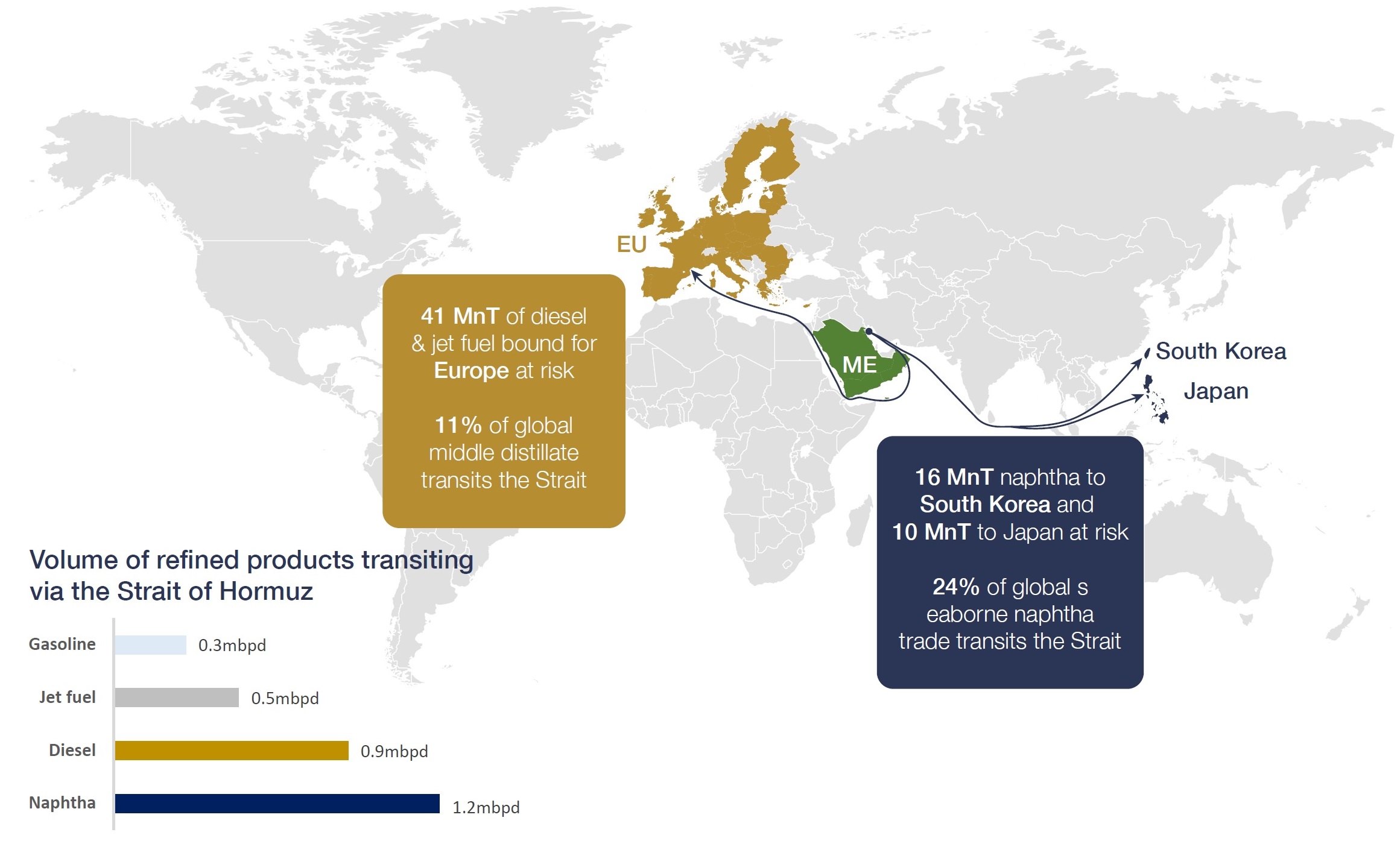
Naphtha is the most highly exposed refined product in this escalating conflict after diesel and jet fuel
Source: Drewry Maritime Research
Naphtha flows at risk; the situation could boost US and Indian exports
The Strait of Hormuz accounts for about 1.2 mbpd of naphtha flows, with 72% destined for Northeast Asia, particularly South Korea and Japan. In the short term, the Asian petchem market is likely to experience a shortage of naphtha amid reduced Middle East loadings, potentially leading to increased naphtha imports from India and the US. If the disruption persists, the vessel will reposition, particularly towards the Atlantic. The US will benefit more, as it can increase shale oil production when oil prices surge. As a result, tonne-mile demand for LRs will increase during this churning, thereby boosting freight rates.
However, in the long run, the prolonged closure will lead to lower refinery runs, reducing petchem feedstock supplies and eventually wiping out 24% of global seaborne naphtha that transits through the Strait.
Diesel and jet fuel disruptions hit Europe
About 1.4 mbpd of diesel and jet fuel passes through the strait, with 60% bound for Europe and 20% for East Africa. Europe is already struggling with a diesel deficit, and losing Middle East supply will force it to pivot to alternate suppliers such as India and the US, raising the average voyage distance and thus, freight rates of LRs. Meanwhile, Nigeria’s Dangote refinery can also benefit from this situation. Dangote started producing Euro-compliant diesel but faced rejection in Europe for failing to meet ‘winter grade’ standards. However, in such a supply crunch, Europe could consider buying diesel from Nigeria.
Short-term gains for refiners, long-term risk of crude supply
In the short term, we expect refiners to increase their run rates as higher energy prices will boost refinery margins. A shift in trade patterns will also expand the average voyage distance, thereby supporting shipping rates. In the medium term, refiners will draw down inventories and raise the run rate at attractive rates, which will boost exports. However, the situation could change if the disruption persists as the strait remains a critical oil chokepoint for crude oil trade, and a prolonged disruption would tighten the supply from the world's largest producing region. As feedstock becomes hard to procure, refiners will be forced to limit refinery runs, contracting the supply of refined products. Once the new trade pattern normalises, the initial spike in freight rates will disappear as the product tanker market is already oversupplied.
Return to...
Related Content
Key Contacts




© Copyright 2026 | Drewry Shipping Consultants Limited. All Rights Reserved. Website Terms of Use | Privacy Policy