
 close
close

We've brought all our trackers and market indices together in a single hub page. Please Register and Login to access this free content.


Drewry’s AIS shows a structural shift in Capesize cargo flows over the past few years
Drewry’s AIS data indicate a structural shift in Capesize cargo flows, driven by the rise in bauxite shipments and the gradual retreat in global coal trade on large vessels. These changing patterns are boosting the utilisation of the Capesize segment.
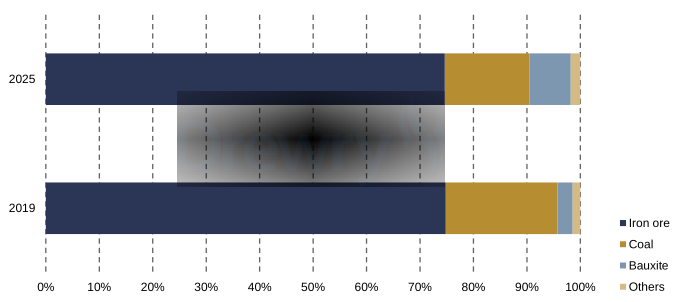
Drewry AIS data shows that Capesize shipping has undergone notable shifts in its commodity mix over the years. Although total Capesize cargo volumes in both 2019 and 2025 stayed broadly similar at over 1.8 billion tonnes, the share of bauxite has steadily increased, while coal’s share has contracted. Iron ore continues to dominate the trade, accounting for about 75% of total volumes.
Before the pandemic, coal was the clear secondary anchor for Capesize employment, but its share slipped from 21% in 2019 to 16% in 2025, reflecting a gradual decline in long-haul coal movements. Interestingly, bauxite has emerged from being a marginal trade to a meaningful one. Its share strengthened from a negligible 3% in 2019 to around 8% by 2025, driven largely by expanding flows out of West Africa into China. The recent change in commodities has had implications for vessel earnings and market dynamics.
The increased long-haul bauxite demand has effectively created more competition for Capesize capacity. For instance, average Capesize TC rates in 2025 are almost 20% higher than in 2019, while those of Panamax jumped only about 10% over the same period.
The emergence of the Guinea–China iron ore route will support the Capesize earnings once the mines begin operations at full scale. Even before Simandou reaches full scale, Guinea has become a busier loading hub, and these cargoes are competing for the same Capesize pool. Once the Simandou mine ramps up capacity to the projected 120 million tonnes over the next three to four years, most of which will head to China, the vessel segment could experience another structural uplift. Existing bauxite transhipment operations and anticipated iron ore transhipment in Guinea already create significant loading delays and waiting times, stretching voyage durations and absorbing more Capesize days out of the trading pool.
Overall, Capesizes are likely to outperform other dry bulk segments due to the various changes discussed above. This segment will also be supported by new long-haul trades, tighter effective supply and a fundamentally altered commodity landscape.
Conclusion
The Capesize market is no longer driven only by iron ore and seasonal swings. New long-haul trades and increased operational delays are quietly absorbing more tonnage, giving rates a stronger floor than in previous cycles. As these structural shifts deepen, especially once Simandou’s volumes hit full capacity, the Capesize segment will maintain its rate premium.
Return to...
Related Content
Key Contacts




© Copyright 2026 | Drewry Shipping Consultants Limited. All Rights Reserved. Website Terms of Use | Privacy Policy