
 close
close

We've brought all our trackers and market indices together in a single hub page. Please Register and Login to access this free content.


Excessive ordering to hurt long-term prospects of VLCCs
The VLCC market is enjoying a strong upswing, with spot earnings consistently exceeding $100,000pd as rising OPEC supply has boosted vessel demand in the Arabian Gulf. With OPEC+ targets indicating an oversupplied oil market through 1Q26, the corresponding firm stocking requirements are expected to support elevated VLCC earnings in the near term.
Meanwhile, skyrocketing freight rates have resulted in a sudden surge in VLCC ordering with 27 VLCCs ordered so far in November. Although the overall 58 VLCC ordered in the first 11 months of 2025 is still lower than 68 VLCCs ordered during the same period last year, a sudden surge in new orders towards the end of 2025 is alarming.
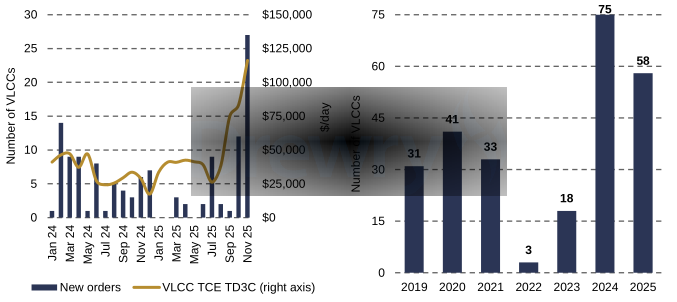
VLCC new orders were subdued in 2022-23 because of tight slot availability with yards, before surging in 2024 due to high pent-up demand once shipbuilding slots for 2026-27 deliveries opened up. After a strong 2024, tonnage ordering remained moderate during the most part of 2025 before surging in October–November which coincided with the skyrocketing freight rates. Attractive freight rates in the crude taker market over the last two years improved the bottom line of tanker companies and many listed crude tanker owners used this opportunity to deleverage and renew their fleet. Following the recent ordering spree, the VLCC orderbook has now surged past 15% of the existing fleet, which could hurt the sector’s long-term prospects if such heavy ordering persists.
The current overheated VLCC freight market reflects a combination of persistent oil oversupply and sluggish fleet growth. As long as the market remains unbalanced, VLCC owners are likely to enjoy elevated rates, but once oil fundamentals tighten and stocking demand fades, VLCC tonnage demand could fall sharply. The situation will be compounded by a wave of new vessel deliveries expected in 2027, which is likely to further pressure VLCC utilisation.
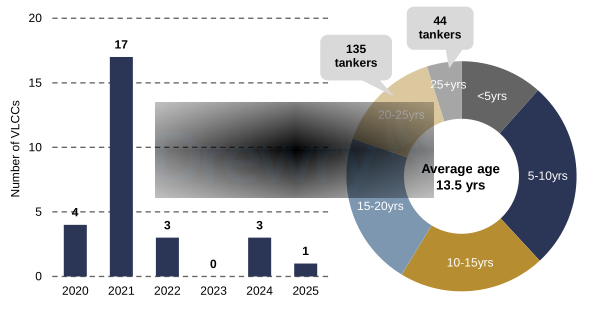
The extent of correction in the VLCC freight rates will also hinge on the pace of phasing out of old tonnage. With scanty demolitions over the last four years, the average age of the VLCC fleet has surged past 13 years, which bodes well for the market rebalancing. As more than 170 vessels in the fleet are above 20 years old, the current orderbook of 158 VLCCs doesn’t look overwhelming. However, the pace at which these old vessels will head towards the scrapyards is highly uncertain especially cosidering that many old tankers are employed in the grey trade.
There is little doubt that VLCCs will enjoy stronger long-term demand prospects than their smaller counterparts. Asia-bound long-haul crude trade, where VLCCs dominate, is set to continue expanding at least through the medium term, while short-haul westbound flows, primarily served by mid-size tankers, are expected to decline. However, a likely deceleration in global oil demand (including Asia) in the coming years, irrespective of when oil demand eventually peaks, suggests that VLCC demand will also taper down gradually. We therefore caution owners to exercise restraint, as any oversupply in the tanker market due to overzealous ordering of tonnage will take longer to rebalance in a fast-saturating oil market. Ordering should remain as close to replacement tonnage demand as possible to keep the market balanced.
Return to...
Related Content
Key Contacts




© Copyright 2026 | Drewry Shipping Consultants Limited. All Rights Reserved. Website Terms of Use | Privacy Policy