
 close
close

We've brought all our trackers and market indices together in a single hub page. Please Register and Login to access this free content.


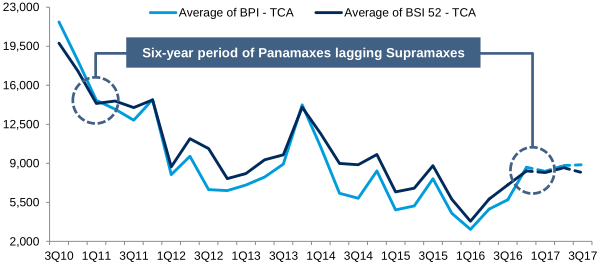
Panamax surges ahead of Supramax
The recent surge in the Panamax rates looks sustainable in the medium term as its demand is propelled by improved coal trade on the Australia-China route and the increasing soybean and corn trades from the Americas (US and Brazil) to Asia. Additionally, as per the sample fixture analysis, the average parcel size for commodities, other than iron ore, has also increased over the years, creating a preference for Panamaxes over Supramaxes in many cases, especially on long-haul.
Supramax trades higher than Panamax ($ per day)
Note: Panamax - 74,000 dwt
Source: Baltic Exchange
One of the major reasons behind the recent surge in Panamax rates has been low deliveries and high demolitions since 2016, compared to Supramaxes substantially reducing the supply growth of Panamaxes over the past two and a half years. Since 2016, Panamax deliveries have been 38% lower than that of Supramax in terms of dwt, while demolitions have been 32% higher, helping the Panamax supply growth to slow down. During 2013-16, the Panamax fleet expanded by 2.8%, while the Supramax fleet expanded by 5.6% annually, helping the Panamax rates recover faster than the Supramax rates.
The average Baltic Panamax TCA remained below the Supramax segment for most of the period since the first quarter of 2011. During 2011-15, the Panamax fleet expanded by 8.4% annually, while the Supramax fleet expanded far slower, at an annual growth of 6.9%. This is the major reason why Panamaxes, despite being bigger than Supramaxes, earned less in that period. Additionally, the demand for non-iron ore commodities remained in smaller parcel sizes. However, the trend is witnessing a structural change, helping increase the demand for Panamaxes.
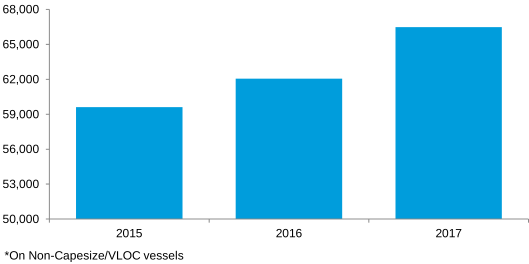
The average parcel size, based on sample fixtures for commodities other than iron ore (on Non-Capesize/VLOCs), has grown over the years from 59,600 tonnes in 2015 to 66,500 metric tons in 2017. It looks sustainable in the medium term, mainly because of two reasons – First, China has been trying to reduce its pollution levels by replacing low-quality coal with high-quality Australian coal, increasing the coal trade in the Pacific. Second, the demand for soybean and corn in Asia is expected to continue increasing. The Baltic Panamax 4TC FFA has been reported to be higher than the Supramax FFA until 2019, in line with our analysis and expectations.
Non-iron ore average parcel size (tonnes)
Source: Baltic Exchange
The current Panamax orderbook is 6.5% of the Panamax fleet, while the current Supramax orderbook is 5.8% of the fleet, which would mean that in the long run, the Panamax fleet could grow faster than the Supramax fleet. In such a case, the Panamax rates would again come under pressure, as is reflected in the Baltic FFA rates. The Baltic Supramax FFA rates have been reported to be higher than Panamax from 2020.
It is an interesting trend, which could change the dynamics of the dry bulk market. We will explore this trend in greater detail in the next issue of Drewry’s quarterly Dry Bulk Forecaster.
Related Content
Key Contacts




© Copyright 2026 | Drewry Shipping Consultants Limited. All Rights Reserved. Website Terms of Use | Privacy Policy