
 close
close

We've brought all our trackers and market indices together in a single hub page. Please Register and Login to access this free content.


US–Iran war: Implications for the crude tanker market
The ongoing US–Iran conflict has severely disrupted maritime traffic through the Strait of Hormuz—a narrow but strategically vital waterway between Oman and Iran that connects crude oil exporters in the Persian Gulf with global markets.
In response to ongoing arm conflict, vessels are diverting away from the Strait to evade the threat of attack. At the same time, impending withdrawal of war risk cover by several insurers are further discouraging shipowners from transiting the passage.
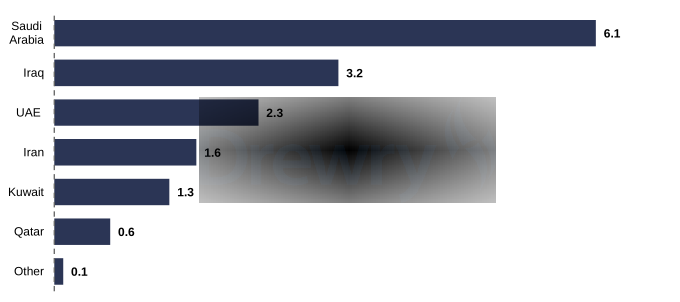
Sustained blockade in crude flows through the Strait of Hormuz would have profound implications for global oil supply and energy security as it handles roughly 15 mbpd of crude oil, equivalent to nearly one-third of global seaborne crude trade. Viable alternatives to bypass the Strait are extremely limited. All major Middle Eastern OPEC producers—Saudi Arabia, Iran, the UAE, Kuwait and Iraq—depend heavily on this route for their crude exports. Although Saudi Arabia, the UAE and Iraq operate pipelines that provide partial overland export options, their combined spare capacity is estimated at only around 4 mbpd. Thus, the current blockade has disrupted more than 11 mbpd of crude supply, potentially triggering a sharp spike in oil prices, heightened market volatility and significant downstream effects on inflation and economic growth worldwide. Meanwhile, oil markets have already begun pricing in heightened geopolitical risk. Brent Crude futures climbed from $73.15 per barrel on February 27—prior to the outbreak of hostilities—to $79.11 per barrel by March 2, following retaliatory strikes in the Gulf.
Figure 1: Crude transits through Strait of Hormuz by exporter (mbpd)
Source: Drewry Maritime Research
Additionally, any sustained spike in crude oil prices would directly lift bunker fuel prices, as marine fuels are derived from refinery feedstocks linked to crude benchmarks. Higher feedstock costs would therefore translate into elevated bunker prices across major bunkering hubs. In a scenario of prolonged supply tightness, refiners may also be forced to reduce throughput due to limited crude availability or margin compression. Lower refinery runs would, in turn, constrain the production of fuel oil and marine gasoil, tightening bunker supply. The combined effect of higher input costs and restricted output would place sustained upward pressure on bunker prices, which would significantly increase voyage expenses and operating costs across shipping sectors.
While approximately 88% of crude passing through the Strait of Hormuz is destined for Asian markets—with China, India and Japan as the largest importers—the ongoing disruption would tighten global oil supply. Even though the direct exposure is highest in Asia, constrained supply through this critical chokepoint would tighten the global oil balance and amplify competition for alternative cargoes.
Short-term implications for crude tankers
Given the strategic importance of the Strait of Hormuz to global oil supply, the duration of any disruption is critical. In the immediate aftermath, there will be chaos as buyers scramble to secure alternative barrels from West Africa, Latin America and North America.
Although OPEC+ has announced a production increase of 206 kbpd from April, such incremental additions would offer little relief if the Strait remains closed. Spare production capacity outside the Middle East is limited, meaning replacement volumes would be insufficient to offset a large-scale disruption of Gulf exports.
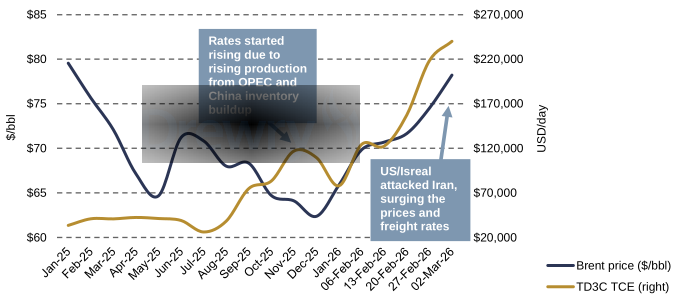
A sudden tightening of Middle Eastern crude flows would not only drive oil prices sharply higher but also trigger a strong rally in tanker freight rates. As importers diversify sourcing strategies, long-haul trade routes—such as US Gulf/West Africa to Asia—would expand significantly. This would increase ton-mile demand and require rapid vessel repositioning, temporarily tightening available tonnage.
In particular, Very Large Crude Carrier (VLCC) rates—already elevated due to tight fleet availability and concentrated ownership—could spike to new highs. The combination of heightened risk premiums, longer voyage distances, and short-term logistical inefficiencies would strongly underpin spot earnings across crude tanker segments.
Implications of a Prolonged Disruption
The more critical question is the duration of the conflict. With limited spare capacity outside the Middle East, any extended closure of the Strait of Hormuz would push oil prices into uncharted territory. Sustained price spikes could eventually erode oil demand and may prompt economies to seek alternative energy sources such as coal to substitute oil.
In the event of prolonged supply disruption, refineries would initially draw down commercial crude inventories. Governments would likely release barrels from their Strategic Petroleum Reserves (SPRs) to stabilise domestic markets. However, these measures are temporary buffers rather than structural solutions. As inventories are drawn down and emergency reserves are utilised, global crude trade volumes would gradually decline. Lower trade volumes would ultimately reduce tonnage demand, placing downwards pressure on freight rates after the initial surge.
That said, inventories are finite and the global economy remains structurally dependent on Middle Eastern crude supply. According to the latest data from the International Energy Agency, OECD commercial oil inventories currently cover approximately 62 days of forward demand. Even assuming a 20% global supply deficit, such inventories would only provide a temporary cushion.
Therefore, while crude tanker markets may initially experience a sharp rate spike, prolonged disruption would eventually shift the dynamic from tonne-mile expansion to demand destruction and trade contraction—leading to a more complex and potentially weaker freight environment over the medium term.
Return to...
Related Content
Key Contacts




© Copyright 2026 | Drewry Shipping Consultants Limited. All Rights Reserved. Website Terms of Use | Privacy Policy