
 close
close

We've brought all our trackers and market indices together in a single hub page. Please Register and Login to access this free content.


Middle East conflict creates short-term volatility in dry bulk trade and demand
Escalating Middle East tensions risk disrupting nearly 30 million tonnes of dry bulk trade per month, equivalent to over 1,000 billion tonne-miles, or more than 7% of global dry bulk shipping demand. However, vessel diversions from the Red Sea via the Cape of Good Hope and potential for substitution of oil and gas with coal amid higher oil and gas prices provide partial upside to dry bulk demand, particularly for Supramaxes and Panamaxes.
Scale of dry bulk exposure
The Middle East is a major dry bulk trading hub as the region imports more than 150 million tonnes of dry bulk commodities annually, including grain, iron ore, coal, sugar, rice, steel products, cement and clinker and exports a similar volume, around 150 million tonnes of fertiliser, gypsum, limestone and other minor bulks.
In addition, intra-regional dry bulk trade amounts to roughly 50 million tonnes per year, largely consisting of aggregates, sand and steel products. In total, this implies that dry bulk cargo movements of nearly 30 million tonnes per month, both international and intra-regional, are at risk of disruption.
The average haul length for international dry bulk trade linked to the region is approximately 6,000 nautical miles, with cargoes primarily destined to India, China, the US, Europe, Canada and Brazil. Imports originate from Russia, India, China, Turkey and the US. This translates to more than 1,000 billion tonne-miles of shipping demand, a little over 7% of global dry bulk shipping demand. Notably, more than 40% of this trade is carried on Supramax vessels, making this segment particularly exposed.
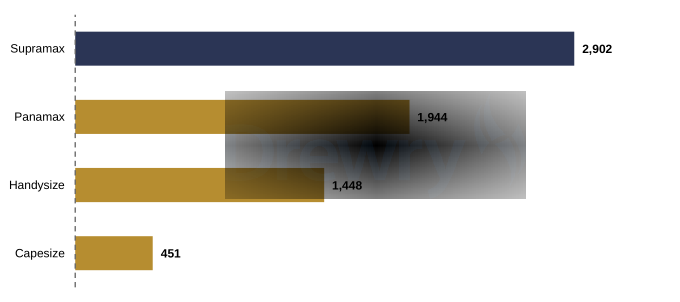
In addition to cargo disruptions, vessel exposure is significant. Dry bulk vessels undertake approximately 7,000 transits through the Strait of Hormuz each year, underlining the scale of dry bulk exposure to any escalation in security risks or access restrictions. This translates to roughly 20 passages per day. Any sustained disruption or closure would therefore have immediate knock-on effects on fleet deployment, voyage economics and regional trade flows, even if actual cargo volumes are partially diverted or deferred.
Disruption to regional trade flows
Trade to and from the Middle East would be disrupted as shipowners and charterers avoid exposure to elevated security and insurance risks. Vessel calls to affected ports are likely to be deferred or cancelled, resulting in an immediate halt or sharp slowdown in dry bulk cargo movements linked to the region.
Diversions from the Red Sea and longer sailing distances
Even amid the Red Sea crisis over the past year, more than 2,000 dry bulk vessels have continued to transit the Suez Canal every month, although volumes remain below pre-crisis levels. With renewed and heightened threats, these vessels are now likely to avoid the region entirely and divert via the Cape of Good Hope. Such diversions significantly increase voyage distances and sailing days, thereby raising tonne-mile demand and absorbing additional vessel capacity, offering some near-term support to dry bulk demand fundamentals.
Energy market spillovers and coal demand upside
A prolonged conflict would likely tighten crude oil and LNG availability, pushing prices higher. In such a scenario, energy-intensive economies, particularly in Asia and parts of Europe, would be forced to rely more heavily on coal for power generation.
If Middle Eastern energy exports remain constrained for more than a month, coal demand could rise sharply. Asia accounts for nearly 90% of global coal demand, with India, China, Japan and South Korea collectively importing close to 700 million tonnes of thermal coal in 2025, out of total global seaborne trade of just over 1,000 million tonnes. Any incremental coal demand would therefore translate directly into higher dry bulk trade volumes and tonne-mile demand.
Sharp escalation in war risk premiums
War risk premiums are expected to rise dramatically. It has been widely reported that war risk cover will be withdrawn in the conflict affected region. The current cover will terminate on 5 March. Post that the insurers are likely to offer new terms for different micro markets and these terms could be different for each market. Ship operators will have a choice to contract on new terms or opt out of it.
Given the war-related risks in the conflict zone, the coverage and insurance premiums are likely to be dissuasive for shipowners, effectively putting a temporary halt on shipping activity in the region.
Outlook
In the near term, the Middle East conflict is likely to inject volatility rather than a sustained directional shift into dry bulk markets. While regional trade disruptions and insurance cover in the war zone will weigh on cargo flows, longer sailing distances via the Cape of Good Hope and a potential rise in coal trade offer meaningful offsets. A prolonged disruption, especially to energy supplies, would tilt the balance towards firmer dry bulk demand, with Supramax and Panamax segments standing to benefit the most.
Return to...
Related Content
Key Contacts




© Copyright 2026 | Drewry Shipping Consultants Limited. All Rights Reserved. Website Terms of Use | Privacy Policy